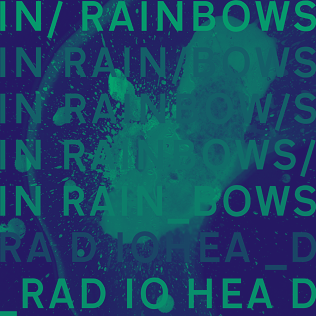
• All my heroes are dead

    You could say I’m a fan of Radiohead. You could say I’ve spent more than half of my life listening to them, own all of their albums, tattooed myself with lyrics from Karma Police before I was even 20 years old, have seen them in concert on multiple occasions and in multiple countries, each experience rapturous. Yes, you could say I am invested.

    And yet, today I sit here disillusioned by this group of five men from Oxfordshire, who are nowadays looking much less like keen-eyed and sharp-tongued auteurs and more like lolling middle-aged rock stars (Jonny Greenwood basically said as much while promoting his artisanal olive oil brand — the very existence of which says all you need to know). Nowhere has this shift  felt more apparent than the band’s “can’t we all just get along” stance on Palestine. 

    This isn’t new territory for Radiohead, admittedly. Ahead of a 2017 Radiohead concert in Tel Aviv, Roger Waters publically encouraged Radiohead to cancel the concert in support of the BDS movement. This came after repeated attempts at private discussion. Many Radiohead fans expressed support for Waters’ perspective. Thom Yorke responded in a lengthy statement that lambasted Waters and BDS — saying that their “black and white” way of thinking was unproductive, and demands paternalistic at best. The concert went on as planned. 

    Now, in light of the daily starvation, murder, and ethnic cleansing happening in Gaza, fans have renewed their requests to the band to stand up for Palestine. I am among them. I admit, my desire to have Radiohead speak on the issue is rooted in equal parts altruism and selfishness. I believe that we all have a moral calling to amplify the cries of Palestinians to the best of our ability. I also hope that artists who have been so important to me are brave enough to agree.

    Last week, Thom Yorke — who, by the way, has released four albums and toured extensively in the last two years — finally released a statement via his Instagram. I admit I was optimistic as I began reading Yorke’s perspective on, as he put it, “the unfolding humanitarian catastrophe in Gaza.” My hopes quickly fell. 

    What could have been a long-awaited opportunity to correct the record and join the chorus of voices in support of the oppressed was, instead, a pale lamentation on celebrity coupled with half-baked centrist politics. Yorke expressed surprise that his “supposed silence was somehow being taken as complicity” and that the “social media witch-hunts” have taken a “heavy toll on [his] mental health.” I can’t say for sure, but I imagine the mental health toll of watching your entire family burn alive is likely worse. 

    Yorke pressed on: “[T]he unquestioning Free Palestine refrain that surrounds us all does not answer the simple question of why the hostages have still not all been returned?” Ignoring the fact that this sentence structure resembles a college freshman’s attempt to appear erudite, Yorke’s derision of pro-Palestinian activists as unthinking horde cut to my core; cut through 15 years of admiration, late nights driving home alone, taking the long way so I could sing along to In Rainbows, posters taped above bedframes, and songs carefully selected for mix tapes. 

    The man I have so long felt a connection with has turned out to be a paper-thin bourgeois faux-intellectual fence-straddler. His words are the words of those who wish to be perceived as progressive, while maintaining their access to comfort and power. 

    Yorke’s statement concluded with finger-pointing at Netenyahu and Hamas, as opposed to a century-old colonial settler project, and platitudes about how much is meant to transcend borders and other self-serving bullshit. Maybe the fault was mine to begin with. What was I thinking, idolizing a 56-year-old British man? It was a project doomed to fail from the start. Either way, I am left wondering where to go from here. 

    Maybe I shouldn’t wonder too hard. Centering myself and my feelings makes me no better than the man who I have allowed to let me down for the last time. 


  • Waiting for my invitation

    Unfortunately, I am thinking about Substack again. 

    This latest period of anxious hyperfixation was brought on by the recent New Yorker article “Is the Next Great American Novel Being Published on Substack?” Though I think the answer is clearly “no,” the author of the New Yorker piece paints an of-the-moment portrait of literary life playing out across newsletters that left me feeling restless. 

    Of course I have pondered starting a newsletter! I have gone so far as to register for a Substack account, spend several hours formatting my page just so, and then proceeding to never write a single word. 

    Though I envy the writers who have managed to transform Substack into a vehicle for literary buzz and PayPal account deposits, I know I don’t have what it takes to do the same. It’s not because I don’t think I can write snarky Selling Sunset recaps as well as the next former NYU student — it’s because I really, truly do not care to read anyone else’s Substack. I cannot bring myself to care! My inbox is a sea of expired Sephora coupons and articles about unlikely animal friendships shared by my parents — how could one person possibly have the capacity to add thinkpieces about Sally Rooney to that mix? I simply cannot do it! 

    Present here is also an element of fear. The rise of Substack writing is symbiotic with the ways that writers — and artists in general — are increasingly expected to exist as a brand; a commodity for consumption. So and so is the ethereal fashion critic, the socialist political analyst, the pop culture connoisseur. Am I afraid because I don’t wish to box myself in — or because I am afraid that I don’t have a point of view? 

    I write this blog — obviously. I used to write regularly on Medium, though I think the site has all but dissipated into irrelevance. I sometimes wonder if Substack is doomed to a similar implosion. Having this wee corner of the internet feels different than having a newsletter, though. It simply exists. I can convince myself I am writing in the spirit of Mark Fisher! (She said only somewhat ironically). 

    As I sit here and ponder these asinine questions, the fact is really this: I have spent the last 10 or so years waiting around for a formal invitation into the literary community. Literally. I have basically imagined that one day Emily Greenhouse is going to send me a letter formally inviting me into the inner circle of the literary elite. Then I will be taken seriously! 

    My bitter streak is no secret. I have aligned myself with the type of modern writer who longs for a literary world that no longer exists, despite the fact I’ve never actually lived in that world myself.  My adolescence was dominated by blogs, and my early 20s was the golden era of Vice and BuzzFeed, before those publications gave way to pathetic union busting and eventual uselessness. 

    When I read an article like the New Yorker piece, about what all of these wonderful writers are doing, it’s like I imagine a big room filled with interesting conversation, and I am peering through the window, my heavy breath fogging up the glass. I imagine something concrete and tangible, when the reality is that community is what you made of it. And that is an incredibly frustrating realization because it means that such a thing could never live up to the dreampalace that I have spent so long constructing. 

    But maybe that also means I don’t have to wait for the invitation anymore. Maybe it means the power is in my hands.


  • The State of My Nightstand

    A stack of books on a nightstand, with a water bottle next to the stack.
    • 矢沢あいの「ナナ」v2 | “Nana” vol. 2 by Ai Yazawa
      • It’s difficult for me to write about “Nana” because the series has shaped me more than any other book, movie, tv show, album. I have long said I will write some definitive piece about the series, but can never actually bring myself to do so. In the meantime, I am re-reading the series as part of a virtual book club and enjoying every moment.
    • 角野 栄子 の 「魔女の宅急便」| “Kiki’s Delivery Service” by Eiko Kadono
      • Kiki’s Delivery Service may well be my favorite film by one of my favorite directors, so of course I had to read the book that inspired the movie. My Japanese is at a level where enjoying middle-grade literature is no problem — yet this book has proven extremely challenging. It’s full of slang and dialect that’s hard to parse on the page. As a result, what should be a fun and light read has taken me now more than 6 months to slog through.
    • あずまきよひこの「よつばと!」v16 ”Yotsuba” vol. 16 by Kiyohiko Azuma
    • The Legend of Meneka” by Kritika H. Rao
    • Fifty Sounds” by Polly Barton
      • Barton is one of my favorite translators of Japanese to English, so I was very happy to come across this book at the library. Part memoir, part theory, part unnecessary references to Kierkegaard. Though I am not sure I am actively enjoying this book, I am glad it crossed my path.
    • If Only” by Vigdis Hjorth
      • I am captivated by this extremely strange novel. I was previously unfamiliar with Hjorth, but quickly became interested when the book jacket touted her as the “Nordic Annie Ernaux.”
    • Bralette Zine vol. 1
      • I bought this zine on a whim when I stopped in to the lovely Print Bookstore in Portland, Maine. It’s delightful!
    • This is How You Lose the Time War” by Amal El-Mohtar and Max Gladstone
      • I need to rectify my status as “the only person who hasn’t read this.”
    • The Goodbye Cat” by Hiro Arikawa
    • 青木美沙子の 「まっすぐロリータ道」| “I’ll Always be a Lolita” by Misako Aoki
    • The Song of Achilles” by Madeline Miller
      • Again, am I the only person who hasn’t read this? I’ve been contemplating doing a “summer reading list” like we used to do in school, and I think this would be at the top of the list.
    • Read Real Japanese” edited by Michael Emmerich
    • Light in Gaza” edited by Jehad Abusalim, Jennifer Bing, and Mike Merryman-Lotze
    • The Artist’s Way” by Julia Cameron
      • I committed to The Artist’s Way program last year, but fell off about halfway through. I think it’s a wonderful, generative, and restorative exercise. This is languishing on my nightstand as a reminder that I should give it another go.
    • クッキー雑誌2024年11月刊 | Cookie Magazine, November 2024 Edition

    Am I actively reading all of these books? No. Is it comforting to know that certain books are just a stretch away at any given moment? Yes.


  • Bridget Jones’s Body

    Despite my profound passion for the film genre that can only be described as “early 2000’s romantic comedy with a Rotten Tomatoes score of 37%” I had never, until recently, seen Bridget Jones’s Diary (2001). Then, within the span of a week, I had seen all four.

    Though I had never seen the series, I was familiar with the films. More specifically, I was familiar with the dialogue surrounding Bridget Jones’ — and therefore Renée Zellweger’s — weight. When an actor gains or loses a significant amount of weight for a role, people practically mythologize the experience. I wasn’t even ten years old when the first Bridget Jones movie debuted, yet I remember well the public scrutiny typically-slender Zellweger faced for her transformation into the curvy Bridget Jones. It was essentially imprinted upon me that a woman weighing 136 pounds was shockingly and disgustingly fat to the point of no return. Cue the lifelong body dysmorphia experienced by millennial women the world around…

    And yet, actually watching Bridget Jones’s Diary, I was surprised to find my impression of the film’s discussion around body image in stark contrast to what was portrayed. Yes, Bridget Jones is fixated on her weight. She records the numbers on the scale in her diary, forces her body into uncomfortable shapewear, and withstands the belittling comments of her family and friends. Are these not universal experiences?

    More importantly, Bridget Jones is actually portrayed as sexy and lovable. Despite her mother’s attempts to stuff her into the matronly and shapeless sacks that haunt the plus size section, Bridget Jones wears miniskirts and gauzy tops to the office. She confidently shows up to a garden party in a Playboy Bunny ensemble (weird this movie came out four months before Legally Blonde) And of course, she wins the hearts of both Hugh Grant and Colin Firth, with the latter proclaiming he loves Bridget “just the way she is.”

    This refreshing tone continued in Bridget Jones: The Edge of Reason (2004), with Bridget continuing to navigate many of the self-doubts and societal pressures that plagued her in the original. Imagine my shock when I pressed play on my pirated copy of Bridget Jones’s Baby (2016) only to find the titular character a wisp of her former self. As a slender Bridget struts confidently across London’s Tower Bridge, her internal monologue reveals she has finally reached her “ideal weight.” I am sure my neighbors heard me yelp “WHAT?!” at the TV. I braced, awaiting some further explanation, and received none. In a single line, the series resolved one of the main character’s most enduring anxieties.

    As one does, I took to the World Wide Web for further explanation. My first guess was that Zellweger was hesitant to go through another round of bodily transformation for the character — understandable given that many actors say the process is very hard on the body. But no, this wasn’t it. In fact, Zellweger was eager to retake Bridget’s signature shape but was shot down by production.

    In an interview with Entertainment Weekly, Bridget Jones’s Baby director Sharon Maguire explained the change: “We all really loved the notion that Bridget, 15 years on, had finally reached her ideal weight … somewhere between a UK size 10 or 12 [US 6 or 8] … but still hadn’t solved any of her issues about love and loneliness.”

    Well, hm. I suppose it’s technically true that skinny people can have problems, too (so I’ve heard). Yet I can’t help but bristle that the director’s desire to represent that there’s more to life than obsessing over weight is achieved via thinness. Why not have the character decide to embrace herself — to quote Colin Firth — just the way she is? I found this decision even stranger considering the third film centers on Bridget’s journey through pregnancy and into motherhood. It’s documented that many who struggle with body dysmorphia and self-image face new challenges as the body changes during pregnancy. The director’s attempt to wipe the story clean of any negative body talk ultimately achieves the opposite of the stated intention — thinness wins.

    The most recent installment of the series, Bridget Jones: Mad About the Boy (2025) finds our heroine widowed, raising two children, and struggling to (please forgive me for this horrible cliche) get her groove back. As with the third film, Mad About the Boy is mum on the subject of body image. Zellweger explained: “There’s going to be an obvious evolution, because [Bridget has] moved on in her life and she has a lot of responsibilities. She doesn’t have the luxury of obsessing about certain things that she might have in the past.”

    Of course after Bridget’s “miraculous” transformation in movie #3, I didn’t suddenly expect them to reintroduce the calorie-counting angle (And certainly Zellweger’s perspective is more well-reasoned than the director’s “skinny people can be lonely too :(” take. ((And this is all to say nothing of the fact that Mad About the Boy feels like it takes place in an entirely different universe than the first three films)). But given that Mad About the Boy is to be the final installment in the Bridget Jones franchise, and many are reflecting on the series’ 25-year legacy, body image is inevitably a recurring theme.

    In many ways, it seems that the films are destined to be chalked up to “that series about the British lady who thinks she’s morbidly obese but isn’t even fat and therefore gave all women under 40 lifelong eating disorders.” There are certainly critiques to be made. But I think there is also a great deal of irony in the way that we internalize the film’s messages — the same way that Wolf of Wall Street inspired legions of manchildren who think that the point of the film is to depict what is Good and what You Should Want to Be.

    Bridget Jones, as a character, is an uncomfortably realistic portrayal of what it is to be a woman existing in a culture where thinness = beauty. No, it is not good that she uses the adjective “lard” in relation to herself on a regular basis, but it is refreshing in its honesty. Bridget isn’t even “fat” but she thinks she is fat because of the same pressures that give way to the voices in our heads distorting our self-perception.

    Am I overthinking this? Ever so slightly. Maybe what this really comes down to is that I would rather watch a romantic comedy in which the woman wallowing while eating ice cream actually eats ice cream.


  • Shadow Song