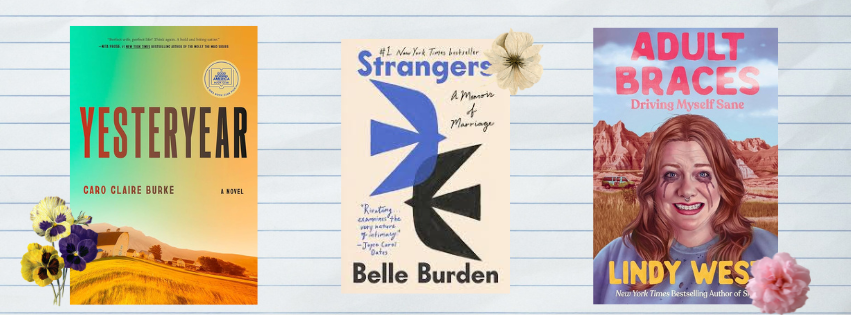
Everyone has an opinion about Caro Claire Burke’s recent debut novel Yesteryear. The novel tells the story of Natalie Heather Mills, a wildly successful tradwife influencer who wakes up one day to find she is transported to 1855. The novel alternates an account of Natalie’s rise to fame with scenes of her struggling to adapt to an all-too-real grueling farm life devoid of nannies, microwaves, and other modern comforts she pretended to be above on her carefully-curated Instagram feed.
Yesteryear is one of the most ambitious books I’ve read in recent memory. Not only in its content, but its use of form and language. Scenes will cut away to prayers, to memories, to streams of hateful thoughts so at odds with Natalie’s external presentation. In the first pages of the novel, Natalie tells the reader she is “perfect at being alive,” and yet the groundwork for collapse into chaos is already being subtly laid.
There are decidedly unsubtle elements of the book, clunky in-your-face lines (“I was heading for hell – I mean, Heaven.”), and plot points that never quite click (why was teenage Natalie, dedicated to her Evangelical upbringing as she was, fixated on attending Harvard?). Yet these hangnails felt like worthy tradeoffs for an author willing to do something strange and unhinged in the sea of disaffected literary fiction. Burke’s writing reminded me heavily of Gillian Flynn’s sharp yet cryptic prose, and multilayered antiheroines.
My enthusiastic reception of this much-maligned book has me wondering if I am the fool. I’ve seen debates as to whether Yesteryear qualifies as literature at all, or is it pop-prose that will fail to withstand the test of time? Is its appeal rooted in shock value; in liberal, atheist snobbery? And what, exactly, is the book even trying to say about our culture?
While online spaces search for a precise thesis statement to pin upon Yesteryear, I do not think that this is a book to be considered through this simplistic, spoon-fed lens. Yesteryear is not a warning, nor it is a conclusory statement – it is a mirror to a reality that already exists. The discomfort experienced within its pages are the same discomforts experienced in our reality.
Some of the most incisive moments of Yesteryear come in the form of characters Caleb and Doug – Natalie’s husband and father-in-law, respectively. Doug is a longtime good ol’ boy politician, and Caleb is, essentially, his useless failson. Natalie sees these men as means to an end: tools she can wield towards stability, towards success, towards wealth and power. For a time, she does so successfully, playing puppetmaster until her life is a pristine depiction of white, Evangelical harmony.
And yet.
Despite the castles built in her mind, Natalie is ultimately an object to be disposed of by these men. Cut off, cast aside, possibly even murdered. No, Natalie is not a martyr or a hero to be emulated – but she is, in men’s eyes, the same as all other women: an object. Her years of planning and striving are so quickly flicked away when they are no longer useful.
Also the subject of this summer’s gossipy book discussion is Belle Burden’s memoir Strangers. Burden’s book recounts her 20 year marriage to her husband, and its sudden, unexpected collapse.
Burden’s memoir differs drastically in style from Yesteryear – every time I read something about ospreys I could practically hear the editor insisting that the story needed some sort of unifying motif – but the books are far more alike than meets the eye.
Strangers presents a universe of glamour not unlike that depicted in Yesteryear. Burden is rich. Extremely rich. A custom, six-bedroom residence in Tribeca, plus multiple other properties rich. Country clubs and private school and helicopters rich. Though Burden does, from time to time, acknowledge her awareness of her own privilege (to varying degrees of success), the lavish depictions of wealth in Strangers are undoubtedly part of the book’s appeal. It’s both aspirational, while also saying “look at how no number of Mongolian cashmere sweaters insulates women from heartbreak.”
Burden and Burke both depict worlds where money is a given, and yet men remain firmly in control. Emotionally and financially in control, without consequence for their misdeeds. Burden’s story ends with her own self-discovery and empowerment, but she also feels tangibly fragile.
After Strangers, I began Lindy West’s new memoir Adult Braces. The book centers around a cross-country road trip of self-discovery as West reckons with her spouse’s polyamory. It’s no secret how that story turned out: since 2021, West has been in a throuple with her spouse and another woman.
West and Burden’s stories bear a striking resemblance in one very particular way: a sense of defensiveness for those who have wronged them. The authors work so hard to ensure that the reader does not harbor negative feelings for what are very clear antagonists. “This book is not about them, this book is about me. A me who just so happens to be reeling from the pain inflicted upon me by one very specific other individual, yet whom I cannot bring to identify as the source of that pain because, despite writing an entire book attempting to excavate that pain, I ultimately intend on granting protected status the source of that pain.”
I’m not being totally fair, I know. Burden has children she must continue to co-parent with her ex-husband, and West remains steadfast in her commitment to her marriage and partnership. Asking for anything but what we are given can quickly turn parasocial. (And we can’t have that!)
These books, and the relationships depicted therein, strike true at the experience of being a contemporary woman attempting to navigate love, self, and power. To be a woman today is to inevitably be filled with an undercurrent of rage, like Natalie in Yesteryear. To be a woman today is to find oneself shirking and small for our own safety, like Belle in Strangers. To be a woman today is to be on a neverending quest for self-love, like Lindy in Adult Braces.
Women are sold a vision of modern life where equality is a given. We supposedly have power – in all these books, the female protagonists are more successful and stable than their romantic counterparts – but these books reflect the ways in which that power is merely a hallucination. The veil of equity is merely a privilege we’ve been granted, and there is an invisible hand lurking, waiting to snatch it away at any moment.

 Katie Fustich