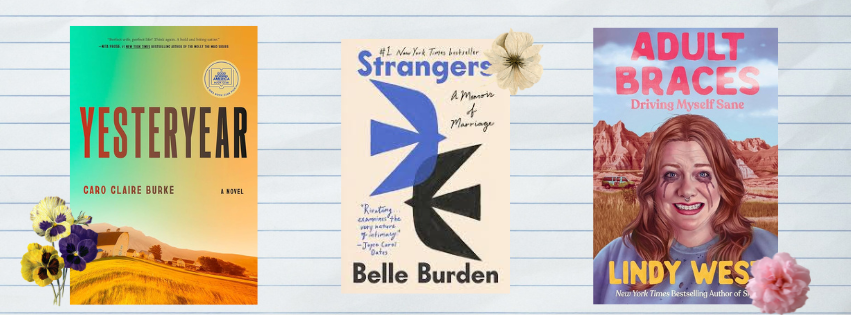
• Yesteryear, Strangers, and Adult Braces: Beach reading that left me questioning modern womanhood

    Everyone has an opinion about Caro Claire Burke’s recent debut novel Yesteryear. The novel tells the story of Natalie Heather Mills, a wildly successful tradwife influencer who wakes up one day to find she is transported to 1855. The novel alternates an account of Natalie’s rise to fame with scenes of her struggling to adapt to an all-too-real grueling farm life devoid of nannies, microwaves, and other modern comforts she pretended to be above on her carefully-curated Instagram feed.

    Yesteryear is one of the most ambitious books I’ve read in recent memory. Not only in its content, but its use of form and language. Scenes will cut away to prayers, to memories, to streams of hateful thoughts so at odds with Natalie’s external presentation. In the first pages of the novel, Natalie tells the reader she is “perfect at being alive,” and yet the groundwork for collapse into chaos is already being subtly laid. 

    There are decidedly unsubtle elements of the book, clunky in-your-face lines (“I was heading for hell – I mean, Heaven.”), and plot points that never quite click (why was teenage Natalie, dedicated to her Evangelical upbringing as she was, fixated on attending Harvard?). Yet these hangnails felt like worthy tradeoffs for an author willing to do something strange and unhinged in the sea of disaffected literary fiction. Burke’s writing reminded me heavily of Gillian Flynn’s sharp yet cryptic prose, and multilayered antiheroines.

    My enthusiastic reception of this much-maligned book has me wondering if I am the fool. I’ve seen debates as to whether Yesteryear qualifies as literature at all, or is it pop-prose that will fail to withstand the test of time? Is its appeal rooted in shock value; in liberal, atheist snobbery? And what, exactly, is the book even trying to say about our culture? 

    While online spaces search for a precise thesis statement to pin upon Yesteryear, I do not think that this is a book to be considered through this simplistic, spoon-fed lens. Yesteryear is not a warning, nor it is a conclusory statement – it is a mirror to a reality that already exists. The discomfort experienced within its pages are the same discomforts experienced in our reality. 

    Some of the most incisive moments of Yesteryear come in the form of characters Caleb and Doug – Natalie’s husband and father-in-law, respectively. Doug is a longtime good ol’ boy politician, and Caleb is, essentially, his useless failson. Natalie sees these men as means to an end: tools she can wield towards stability, towards success, towards wealth and power. For a time, she does so successfully, playing puppetmaster until her life is a pristine depiction of white, Evangelical harmony. 

    And yet. 

    Despite the castles built in her mind, Natalie is ultimately an object to be disposed of by these men. Cut off, cast aside, possibly even murdered. No, Natalie is not a martyr or a hero to be emulated – but she is, in men’s eyes, the same as all other women: an object. Her years of planning and striving are so quickly flicked away when they are no longer useful. 

    Also the subject of this summer’s gossipy book discussion is Belle Burden’s memoir Strangers. Burden’s book recounts her 20 year marriage to her husband, and its sudden, unexpected collapse. 

    Burden’s memoir differs drastically in style from Yesteryear – every time I read something about ospreys I could practically hear the editor insisting that the story needed some sort of unifying motif – but the books are far more alike than meets the eye. 

    Strangers presents a universe of glamour not unlike that depicted in Yesteryear. Burden is rich. Extremely rich. A custom, six-bedroom residence in Tribeca, plus multiple other properties rich. Country clubs and private school and helicopters rich. Though Burden does, from time to time, acknowledge her awareness of her own privilege (to varying degrees of success), the lavish depictions of wealth in Strangers are undoubtedly part of the book’s appeal. It’s both aspirational, while also saying “look at how no number of Mongolian cashmere sweaters insulates women from heartbreak.” 

    Burden and Burke both depict worlds where money is a given, and yet men remain firmly in control. Emotionally and financially in control, without consequence for their misdeeds. Burden’s story ends with her own self-discovery and empowerment, but she also feels tangibly fragile. 

    After Strangers, I began Lindy West’s new memoir Adult Braces. The book centers around a cross-country road trip of self-discovery as West reckons with her spouse’s polyamory. It’s no secret how that story turned out: since 2021, West has been in a throuple with her spouse and another woman. 

    West and Burden’s stories bear a striking resemblance in one very particular way: a sense of defensiveness for those who have wronged them. The authors work so hard to ensure that the reader does not harbor negative feelings for what are very clear antagonists. “This book is not about them, this book is about me. A me who just so happens to be reeling from the pain inflicted upon me by one very specific other individual, yet whom I cannot bring to identify as the source of that pain because, despite writing an entire book attempting to excavate that pain, I ultimately intend on granting protected status the source of that pain.” 

    I’m not being totally fair, I know. Burden has children she must continue to co-parent with her ex-husband, and West remains steadfast in her commitment to her marriage and partnership. Asking for anything but what we are given can quickly turn parasocial. (And we can’t have that!) 

    These books, and the relationships depicted therein, strike true at the experience of being a contemporary woman attempting to navigate love, self, and power. To be a woman today is to inevitably be filled with an undercurrent of rage, like Natalie in Yesteryear. To be a woman today is to find oneself shirking and small for our own safety, like Belle in Strangers. To be a woman today is to be on a neverending quest for self-love, like Lindy in Adult Braces

    Women are sold a vision of modern life where equality is a given. We supposedly have power – in all these books, the female protagonists are more successful and stable than their romantic counterparts – but these books reflect the ways in which that power is merely a hallucination. The veil of equity is merely a privilege we’ve been granted, and there is an invisible hand lurking, waiting to snatch it away at any moment.

    . . .

  • My 2025 in Books

    This year, I read 52 books.

    The books overlapped and intersected with each other, but somehow tidily added up to one book a week.

    Searching for themes, it’s easy to see my grief for my cat, Torby, processed in book form. I lost her just as 2025 began, and found comfort in every cat-related piece of media I could get my hands on. The Traveling Cat Chronicles by Hiro Arikawa is easily my favorite book I read this year, and I will always be so grateful that it was there for me when I needed it.

    2025 was also the year I grew my Japanese studies beyond manga and began reading novels (for grown-ups!). キッチン by Banana Yoshimoto is one of my favorite books in English, and I loved reading it all the more in its original form. Yes, I still read plenty of manga — including the first nine volumes of ナナ as part of an online book club with fellow language-learners.

    One of the most unexpected favorites of 2025 was Kelly Bishop’s memoir, The Third Gilmore Girl. I understand why she chose to title the book as she did, but Bishop’s story — and her storytelling — transcend the label. Her raw stories of life as a dancer in 1970’s New York City have more in common with Just Kids than the fluff of Bishop’s Gilmore Girls co-star Lauren Graham’s Talking as Fast as I Can.

    Stray Observations:

    • I read Honey by Isabel Banta in a single sitting while camping earlier this year. I can’t remember the last time I did that!
    • The excitement surrounding Heated Rivalry honestly sustained me during a tough end to this year. I adore the show and the books are equally as brilliant.
    • It’s rare for me to downright hate a book. Don’t get me wrong, there are times when I love to be a hater. But when it comes to literature I try to be as open-minded and curious as possible. The books in the “not for me” category are books that I did not enjoy reading, but that I respect nevertheless. The books in the “kindling” category are genuine abominations.

    What Will I Read Next Year?

    Middlemarch. Mostly so I can stop talking about how I need to read Middlemarch.

    . . .

  • The State of My Nightstand

    A stack of books on a nightstand, with a water bottle next to the stack.
    • 矢沢あいの「ナナ」v2 | “Nana” vol. 2 by Ai Yazawa
      • It’s difficult for me to write about “Nana” because the series has shaped me more than any other book, movie, tv show, album. I have long said I will write some definitive piece about the series, but can never actually bring myself to do so. In the meantime, I am re-reading the series as part of a virtual book club and enjoying every moment.
    • 角野 栄子 の 「魔女の宅急便」| “Kiki’s Delivery Service” by Eiko Kadono
      • Kiki’s Delivery Service may well be my favorite film by one of my favorite directors, so of course I had to read the book that inspired the movie. My Japanese is at a level where enjoying middle-grade literature is no problem — yet this book has proven extremely challenging. It’s full of slang and dialect that’s hard to parse on the page. As a result, what should be a fun and light read has taken me now more than 6 months to slog through.
    • あずまきよひこの「よつばと!」v16 ”Yotsuba” vol. 16 by Kiyohiko Azuma
    • The Legend of Meneka” by Kritika H. Rao
    • Fifty Sounds” by Polly Barton
      • Barton is one of my favorite translators of Japanese to English, so I was very happy to come across this book at the library. Part memoir, part theory, part unnecessary references to Kierkegaard. Though I am not sure I am actively enjoying this book, I am glad it crossed my path.
    • If Only” by Vigdis Hjorth
      • I am captivated by this extremely strange novel. I was previously unfamiliar with Hjorth, but quickly became interested when the book jacket touted her as the “Nordic Annie Ernaux.”
    • Bralette Zine vol. 1
      • I bought this zine on a whim when I stopped in to the lovely Print Bookstore in Portland, Maine. It’s delightful!
    • This is How You Lose the Time War” by Amal El-Mohtar and Max Gladstone
      • I need to rectify my status as “the only person who hasn’t read this.”
    • The Goodbye Cat” by Hiro Arikawa
    • 青木美沙子の 「まっすぐロリータ道」| “I’ll Always be a Lolita” by Misako Aoki
    • The Song of Achilles” by Madeline Miller
      • Again, am I the only person who hasn’t read this? I’ve been contemplating doing a “summer reading list” like we used to do in school, and I think this would be at the top of the list.
    • Read Real Japanese” edited by Michael Emmerich
    • Light in Gaza” edited by Jehad Abusalim, Jennifer Bing, and Mike Merryman-Lotze
    • The Artist’s Way” by Julia Cameron
      • I committed to The Artist’s Way program last year, but fell off about halfway through. I think it’s a wonderful, generative, and restorative exercise. This is languishing on my nightstand as a reminder that I should give it another go.
    • クッキー雑誌2024年11月刊 | Cookie Magazine, November 2024 Edition

    Am I actively reading all of these books? No. Is it comforting to know that certain books are just a stretch away at any given moment? Yes.

    . . .

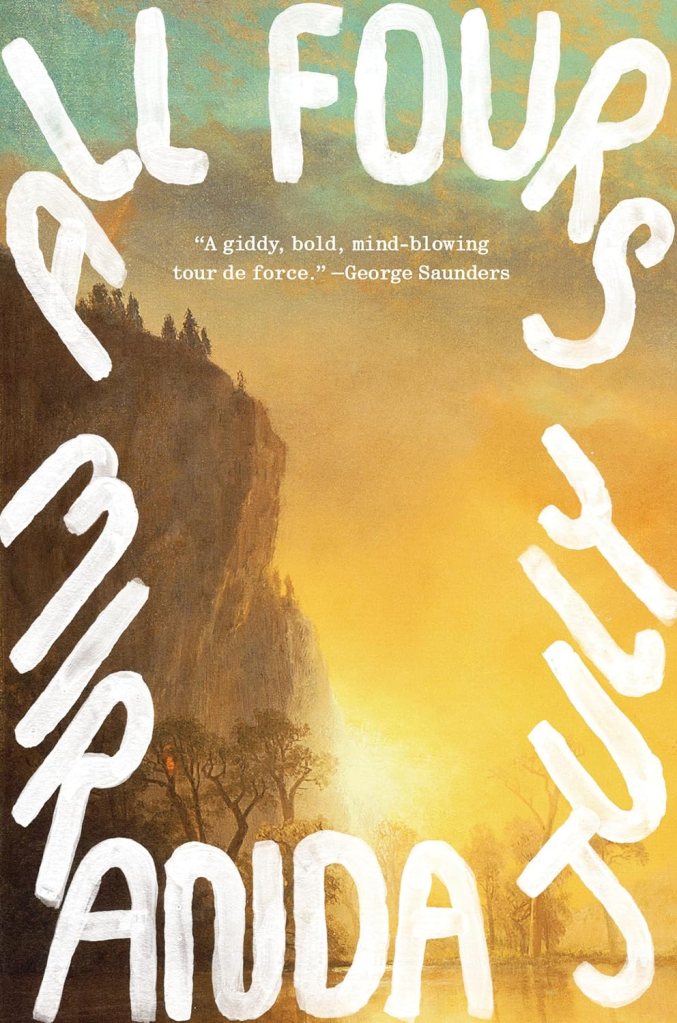
  • “All Fours” by Miranda July

    Sometimes a book comes to you at exactly the right moment in your life. At first, you think it must be a fluke; certainly there will be a fork in the story where the plot deviates from your own reality. But then, sentence after sentence continues to feel like it was constructed personally with your own world in mind. This is a rare experience, and one that should be treasured.

    This was my experience reading Miranda July’s 2024 novel All Fours.

    The first-person narrator is a 45 year-old, semi-famous artist. She and her husband have been together for 15 years, and share a six year-old child, who came into the world via a traumatic birth. The narrator, who lives in Los Angeles, has plans to visit New York. Having never taken a road trip, she decides to drive. She makes it all of 30 minutes outside of Los Angeles before holing up at a motel in Monrovia for two weeks, and setting the wheels in motion on a journey that will upend her relationships, her health, and her way of seeing the world.

    I should now include a caveat that I have not seen/read/experienced any of July’s other work. There may be some other layers to opinions about this book (my own included) that are rooted in an understanding of her broader body of work, but I did not have that coloring my experience of this book — for better or for worse. (As overwhelming as this book was, I am almost inclined not to see her films or read her other stories at risk of damaging the surface tension of this story. But we’ll circle back to that.)

    Back to the book. July does not hold back in her depictions of motherhood, of sex and sexual desire, of marriage. Many of her observations feel like thoughts we all think everyone else is having, but we are all too scared to say out loud. Reading them on the page, hearing them in July’s soft voice, felt like it was changing my life in real time. Raw snippets of conversation would be followed by a metaphor so breathtaking I was jealous I had never thought to describe a sky or a road that way — and then sad that I had never seen it that way — and then hopeful that I could.

    All Fours feels like a spiritual successor to Sheila Heti’s How Should a Person Be and Chris Kraus’s I Love Dick. Stories of creative women approaching middle age, considering the significance of their relationships, their sexuality, their bodies, their minds. Small and insignificant interactions suddenly exploding with meaning. Kraus once referred to her work as occupying the sphere of “lonely girl phenomenology.” Many, many people hate these women and their stories.

    From professional critics to the trenches of GoodReads, you will find declarative statements using words like “icky,” “annoying,” “narcissistic” being made in reference to these books. Many, thinking themselves clever, have proclaimed “these books have no point!” The only solution, therefore, must be the woman’s own insufferable self-obsession, leading her to create such a mindless and inconsequential product. Sometimes I mistakenly think feminism has made progress, and then I peek online to find the most ardent critiques of a book like All Fours have more to do with the narrator’s failings as a wife and mother.

    There is power in these reactions, I suppose. They are in many ways tied to what makes All Fours so brilliant. It captures a feeling, a reality that so many people live with tightly coiled inside themselves. The reactions to the book prove why it must remain inside. Freedom + unfiltered self-expression + grotesque curiosity + uncertainty = bad and undesirable woman. Experiencing these feelings through the page is as close as many people get to living the lives they know they are capable of.

    Though I felt seen line after line, I am decidedly not a 45 year-old, peri-menopausal mother. I am 31 years old and only beginning to grasp the outline of the next stage of my life. Reading the book felt like opening a tome of wisdom of women who came before me. “Here’s what to know” it says. “Now go ahead and don’t be afraid to live the life you want.”

    . . .

  • The 6 Best Books I Read in 2023

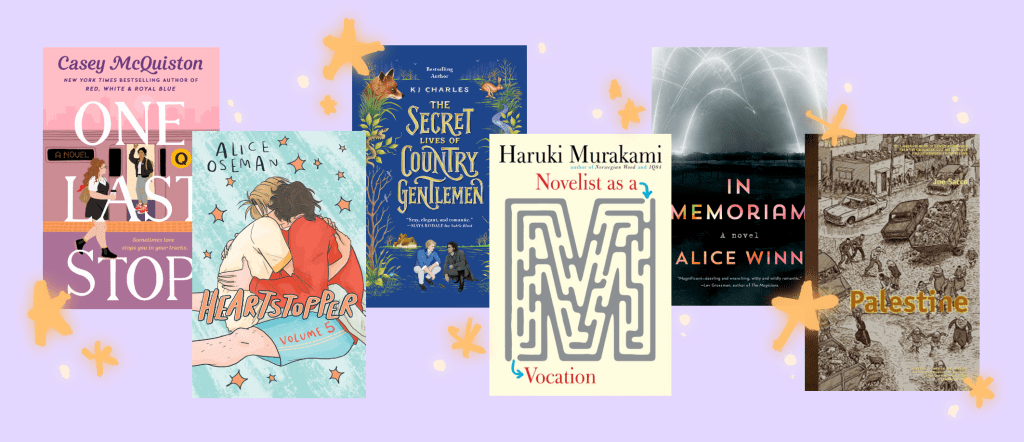
    There are still a few more weeks left of the year, and a few more books on my nightstand, but as of this post I read 55 books in the year of our Lord, 2023. This pace was largely made possible by the overarching reading theme of the year, which was decisively “graphic novels for cool queer teens.” But hey, if I can heal my inner child and get GoodReads cred at the same time, I’m gonna do it.

    It was tough to whittle down what I read this year to a few favorites (I mean, I wanted to do a Top 5 list for a nice round number, and couldn’t even bring myself to do that) but I did my best. Here are the books that will stay with me long after 2023 has drawn to a close:

    In Memoriam by Alice Winn

    In Memoriam is most straightforwardly described as a gay love story set against the backdrop of World War I. Yet, that tagline seems an almost unfair reduction of the ways in which this story subverts expectations about the “war novel” and the “queer historical romance.” You will recoil in disgust at the visceral depictions of life in the trenches, you will grin at the warmth of friendship, and you will sob violently at the complex beauty of the love between the two main characters.

    Palestine by Joe Sacco

    With a genocide unfolding before our eyes in Palestine, taking the time to educate oneself is critical in the fight for liberation. While there are many excellent books on the history of Palestine and its occupation, none I read this year was more impactful than Joe Sacco’s graphic work of nonfiction. Edward Said puts it best in the introduction: “There’s no obvious spin, no easily discernible line of doctrine, […] no attempt to smooth out what is for the most part a meager, anxious existence of uncertainty[.]” Originally published in 1993, Sacco’s work just began printing once again.

    Heartstopper (vol. 1-4) by Alice Oseman

    I somehow missed the Heartstopper train when it left the station a few years back, but was blessed with the opportunity to hop on and become as obsessed as my fellow Tumblr Bisexuals earlier this year. Oseman masterfully depicts the realities of growing up queer, while always leaving more room for joy and friendship than pain. I don’t think it’s an exaggeration to say that this series provides both a safe place for kids who see themselves in Nick and Charlie (or any of the other incredible cast of characters), as well as a reparative space for adults, who were never able to immerse themselves in such a warm narrative.

    The Secret Lives of Country Gentlemen by K.J. Charles

    I don’t think there is a romance author more criminally underrated than K.J. Charles. After devouring everything she has ever penned late last year, I was thrilled by the release of The Secret Lives of Country Gentlemen in April. So thrilled, in fact, I forced my partner to listen to the audiobook with me during a road trip. But in further praise of the wonder of Charles — he was as hooked as I was. The protagonists, stuffy aristocrat Garth and roguish smuggler Joss, are *chef’s kiss*. What really sets the story apart, though, is the social/political/historical commentary that drives the characters and the narrative.

    Novelist as a Vocation by Haruki Murakami

    My thoughts on books about writing and Murakami’s recent works are similar: they are both bad. But when they are good? They transform me into a disciple who will proselytize about This One Book ad nauseum. Novelist as a Vocation is That One Book. Murakami peels back the curtain on his career and delves into the minutiae of his process. Selfishly, when writers write about writing, I want detail, I want clarity, I want a checklist of what someone eats for breakfast every day. This book gives all of that and more. I genuinely feel that reading this has made me a more thoughtful writer.

    One Last Stop by Casey McQuiston

    It’s not easy to explain how a story about an adrift young woman falling in love with a 1970’s punk who just happens to be stuck in time on the Q Train is one of the most loving, joyful books I have ever read — but I will do my best. McQuiston made my heart ache with nostalgia for an early 20’s spent in Brooklyn apartments cluttered with tchotchkes and quirky roommates, falling in love each time I set foot on the subway. The characters, which could so easily have fallen into caricature, are given individual and attention and development that brings them to life. The bond between the protagonists is real and palpable and earnest and radiates off the page. The book is a messy explosion of earnestness and love that made me want to be a better person. I don’t think it gets much better than that.

    . . .