• The 6 Best Books I Read in 2023

    There are still a few more weeks left of the year, and a few more books on my nightstand, but as of this post I read 55 books in the year of our Lord, 2023. This pace was largely made possible by the overarching reading theme of the year, which was decisively “graphic novels for cool queer teens.” But hey, if I can heal my inner child and get GoodReads cred at the same time, I’m gonna do it.

    It was tough to whittle down what I read this year to a few favorites (I mean, I wanted to do a Top 5 list for a nice round number, and couldn’t even bring myself to do that) but I did my best. Here are the books that will stay with me long after 2023 has drawn to a close:

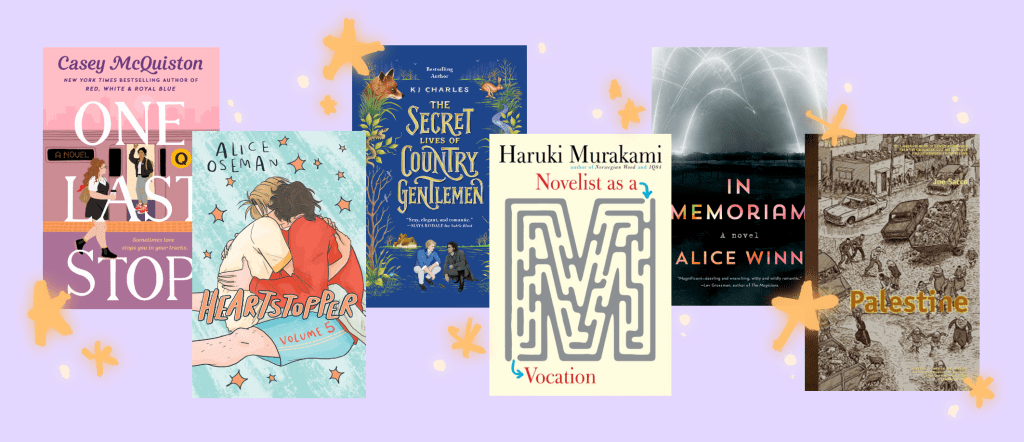
    In Memoriam by Alice Winn

    In Memoriam is most straightforwardly described as a gay love story set against the backdrop of World War I. Yet, that tagline seems an almost unfair reduction of the ways in which this story subverts expectations about the “war novel” and the “queer historical romance.” You will recoil in disgust at the visceral depictions of life in the trenches, you will grin at the warmth of friendship, and you will sob violently at the complex beauty of the love between the two main characters.

    Palestine by Joe Sacco

    With a genocide unfolding before our eyes in Palestine, taking the time to educate oneself is critical in the fight for liberation. While there are many excellent books on the history of Palestine and its occupation, none I read this year was more impactful than Joe Sacco’s graphic work of nonfiction. Edward Said puts it best in the introduction: “There’s no obvious spin, no easily discernible line of doctrine, […] no attempt to smooth out what is for the most part a meager, anxious existence of uncertainty[.]” Originally published in 1993, Sacco’s work just began printing once again.

    Heartstopper (vol. 1-4) by Alice Oseman

    I somehow missed the Heartstopper train when it left the station a few years back, but was blessed with the opportunity to hop on and become as obsessed as my fellow Tumblr Bisexuals earlier this year. Oseman masterfully depicts the realities of growing up queer, while always leaving more room for joy and friendship than pain. I don’t think it’s an exaggeration to say that this series provides both a safe place for kids who see themselves in Nick and Charlie (or any of the other incredible cast of characters), as well as a reparative space for adults, who were never able to immerse themselves in such a warm narrative.

    The Secret Lives of Country Gentlemen by K.J. Charles

    I don’t think there is a romance author more criminally underrated than K.J. Charles. After devouring everything she has ever penned late last year, I was thrilled by the release of The Secret Lives of Country Gentlemen in April. So thrilled, in fact, I forced my partner to listen to the audiobook with me during a road trip. But in further praise of the wonder of Charles — he was as hooked as I was. The protagonists, stuffy aristocrat Garth and roguish smuggler Joss, are *chef’s kiss*. What really sets the story apart, though, is the social/political/historical commentary that drives the characters and the narrative.

    Novelist as a Vocation by Haruki Murakami

    My thoughts on books about writing and Murakami’s recent works are similar: they are both bad. But when they are good? They transform me into a disciple who will proselytize about This One Book ad nauseum. Novelist as a Vocation is That One Book. Murakami peels back the curtain on his career and delves into the minutiae of his process. Selfishly, when writers write about writing, I want detail, I want clarity, I want a checklist of what someone eats for breakfast every day. This book gives all of that and more. I genuinely feel that reading this has made me a more thoughtful writer.

    One Last Stop by Casey McQuiston

    It’s not easy to explain how a story about an adrift young woman falling in love with a 1970’s punk who just happens to be stuck in time on the Q Train is one of the most loving, joyful books I have ever read — but I will do my best. McQuiston made my heart ache with nostalgia for an early 20’s spent in Brooklyn apartments cluttered with tchotchkes and quirky roommates, falling in love each time I set foot on the subway. The characters, which could so easily have fallen into caricature, are given individual and attention and development that brings them to life. The bond between the protagonists is real and palpable and earnest and radiates off the page. The book is a messy explosion of earnestness and love that made me want to be a better person. I don’t think it gets much better than that.
    ,

  • Book Review: The Woman in Me by Britney Spears

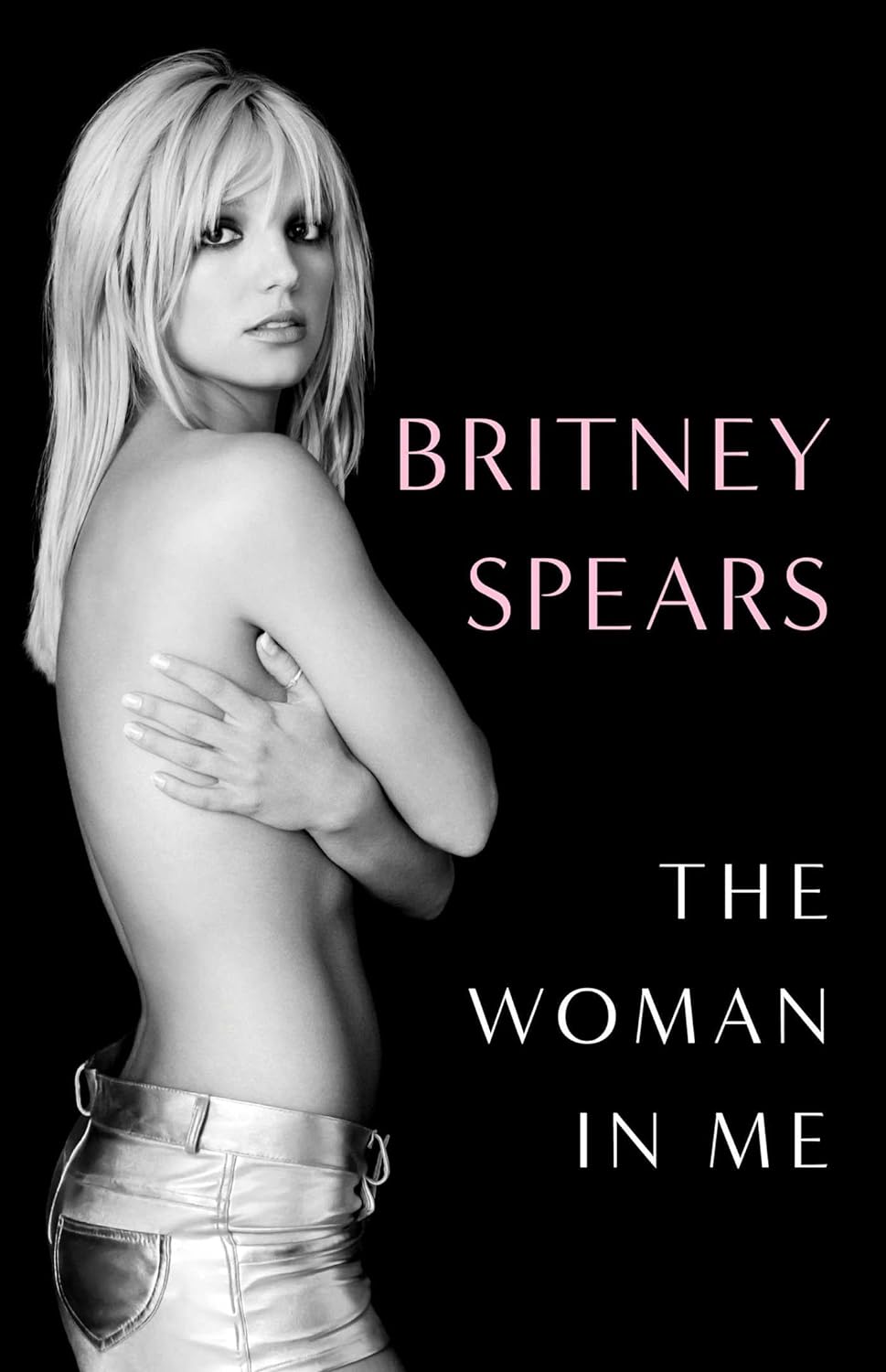
    I don’t think I’ve ever pre-ordered a book as quickly as I pre-ordered The Woman in Me. I even tried to get my hands on an advance review copy (to no avail). For my sixth birthday, I was given a tape of …Baby One More Time, which instantly transformed me into a Britney mega-fan. Within a matter of weeks, I was a card-carrying member of the Official Britney Spears Fan Club (as in I literally had a card in my Velcro wallet). There was a life-sized Britney poster on the back of my bedroom door that greeted me each day. Each time Britney released a new music video, I purchased the accompanying doll that would sing the chorus of the single when you pressed on her silver belly-button ring. You get the idea.

    As a teenager and adult, my childhood obsession waned into a more distant reverence for the artist that shaped me. Then, as a law student, I found myself face-to-face with Spears once again: as a clinical student in a civil litigation clinic, I worked with individuals who were looking to free themselves from guardianships, at the same time Spears was working to free herself from hers.

    For 13 years, one of the most successful entertainers of all time was subject to a legal conservatorship. From 2008 to 2021, Britney Spears’ father controlled her money, her healthcare, and her relationships — while pocketing millions of dollars each year for himself. As the realities of this control became more public, Spears’s fans formed the #FreeBritney movement and engaged in a highly-publicized rallying cry to grant the artist her independence.

    Since freeing herself from the conservatorship, Spears has been on a complex healing journey. Her intertwined feelings of anger, betrayal, liberation, and contentment are often chronicled in lengthy Instagram posts, accompanied by videos of her dancing in her home, or trying on different outfits. The posts are not always straightforward (and when is healing ever linear?), causing some to question Spears’s wellbeing. In early 2023, concerned “fans” requested a welfare check to Spears’s home, resulting in a police presence and a subsequent plea from Spears to respect her privacy. These incidents create an ever-present sense that, though she is technically free, she is forever at risk of being re-victimized by the legal system that held her captive for more than a decade.

    With the neverending vortex of narratives swirling around her existence, Spears announced her memoir in July of 2023. The publisher describing the “groundbreaking” book as “illuminat[ing] the enduring power of music and love–and the importance of a woman telling her own story, on her own terms, at last.”

    On October 24, 2023, the day of its publication, I opened the cover of my freshly-pressed copy of The Woman in Me with high expectations. Immediately, I was struck. Spears opens the memoir with a prologue, reflecting on times as a child when she would escape the chaos of her family home for the nearby woods. There, Spears reflects, she felt peace — she felt God. This search for stillness amidst the chaos is a defining theme of the book. From a childhood spent bouncing between cities and jobs, quite literally feeding her family, to an adulthood sequestered at home so as to avoid the paparazzi, we see the ways in which Spears is so rarely given the opportunity to focus on her own needs.

    As a writer, Spears’s storytelling style is fluid and conversational. At times, I felt like I could imagine Spears sitting at lunch with a friend, or even reclined on a therapist’s sofa, describing the heartbreak of a failed relationship, or the grueling schedule of a world tour. Narratively, this can make timelines difficult to follow. There are chapters that oscillate in time, discussing the era surrounding one album and then hopping back to the one prior. More than once I found myself flipping back a few pages to make sure I hadn’t missed a transition or a reference to a date only to realize there was none. Reflecting on the book as a whole, though, I see how the memoir is not meant to be a linear narrative, but a reflection on a life defined by the tensions between freedom and control.

    While the lead-up to the book’s release focused largely on revelations about Spears’s relationship with Justin Timberlake, one of the key motivations for the existence of the book itself was the conservatorship. Accordingly, the final third or so of the book focuses on the reality she faced for 13 years: no access to her own money, guards controlling her every move, medications forced into her body to make her compliant.

    Then, as swiftly as the conservatorship was imposed, Spears references its end. The book draws to a brisk close in a way that left me imagining the narrator, at lunch or on the couch, was trying to quickly wrap things up and get on with their day. I noticed a similar urge at other inflection points in the book, such as which Spears famously shaved her head while the paparazzi photographed her from outside the salon. Spears’s description of that turbulent time in her life leaves much clearly lurking under the surface, while readers are given clipped justifications.

    This tendency in the book left me deeply conflicted, both by the writing itself and even moreso by my response to it. Spears’s memoir explores the control and manipulation she has been subject to her entire life; being observed and picked apart to the point where it broke her. The book is, in this way, a contradiction: a tell-all memoir that at its core really tells the reader that the world is not owed a full explanation. Yet, as a reader, I found myself doing exactly that: wanting more details, more exposition, more of everything. It was an opportunity, albeit an uncomfortable one, to examine why I felt that sense of entitlement.

    From a literary standpoint, there are flaws in this book. Repetition, odd editing, choices to fixate on throwaway observations in favor of depth and detail. And yet. The Woman in Me triumphs over any critique because of the simple fact that it does exactly what it set out to do: tell Britney Spears’s story in her own words.

    ,

  • An Outlet for the Rage

    Today, I am filled with unspeakable anger. It’s the kind of anger that makes me want to scream, to lash out, to make a fool of myself.

    Earlier today, the Israeli military bombed al-Shifa Hospital. Without electricity, Palestinian doctors are currently keeping 39 newborns alive by hand-pumping oxygen. One infant has already died. This incident alone is unspeakable — a representation of the suffering that humankind is capable of inflicting in the name of settler-colonialism — and yet it is only another minute in another day of a month of bloodshed. 11,000 more Palestinian martyrs lie beneath the rubble of Gaza. Entire families, entire communities. Gone.

    My taxes pay for the bombs used to kill. My government endorses the killing, despite the masses calling for a ceasefire. Around me, people lose jobs and opportunities because they refuse to be complicit in genocide. I have disengaged from friendships, lost respect for professors and colleagues, because they refuse to believe what is in front of us all. How shamelessly they share this information, too. So many masks have fallen to the ground, revealing a lust for blood I didn’t know possible. Perhaps it’s twisted sort of blessing to have the chance to see someone as they really are. Still, I feel shame for the admiration I once felt, and sorrow for what is now forever lost.

    The cognitive dissonance swirls and swirls and swirls without end. How does one function? What is there to do but vibrate with rage?


  • The Return of the Blog

    Does anyone really blog anymore?

    I would require multiple appendages to count the total number of blogs I’ve had in my lifetime. LiveJournal confessionals, scenster-era Xanga pages that were more form than substance, BlogSpot-based chronicles of my high school fashion choices — I even had a short-lived Tumblr dedicated to ranking the quality of my Tinder dates.

    Perhaps the personal blog was bystander casualty in the 2010’s War Against the Personal Essay. “We don’t want writing about your lived experience, we want unreadable experimental writing that thinly veils your lived experience!” and so forth. But as I write this, the number of places to publish (and, you know, read) any kind of non-AI-generated writing is shrinking by the hour. This morning, it was announced that Jezebel would be shutting down after 16 years.

    It make sense that models like Substack are on the rise. Where else do writers have but whatever corner of the internet allows them to carve out a space for themselves? Even better if, like Substack, they promise a profitable, growth-oriented model. Medium did the same thing a few years ago, and after cultivating 2,200 readers and hundreds of thousands of views on my posts there, I earn approximately $0.02 each month. So here I am, keeping my intellectual property to myself and bringing it all back to where it started: the blog.

    There is peace and joy in complete uselessness. I’m pretty sure Thich Nhat Hanh said that. To write without a “growth-oriented” mindset and without the constraints of whatever terrible business decision will land in the publishing industry’s lap next. To do something and remember what it was like to care about it before it fed you.

    The other day on Twitter, writer Jamie Hood declared “the age of irony poisoning is over … earnest girlies rise up!” And I have personally never been more excited for such a cultural shift. I will see you on the blog.


  • New Clips

    Happy March!

    Here’s a few new stories:

    Could the U.S. Ever Have a Viable Third Party?” from DAME Magazine

    In Protest: A Reading List for the Resistance” from Brooklyn Magazine

    Keep fighting the good fight

    xxoo