I first read Octavia Butler’s Parable of the Sower in 2019. Originally published in 1993, Parable of the Sower gained renewed attention in the mid 10’s — reaching the NYT Bestseller list for the first time — for its prophetic depiction of a Trump-like presidency. Parable‘s President Christopher Donner, familiarly, vowed to return a crumbling United States to a long-lost golden age.
The book, at the time, felt foreboding. I distinctly remember the feeling of pique when narrator Lauren Olamina expresses shock at news of a measles outbreak. At the time, a measles outbreak was sweeping through New Jersey. How portentous! I thought. No, the word “portentous” didn’t actually sail its way down my stream of consciousness, but the novel nevertheless struck an excitingly sinister cord — the same feeling I used to get playing Bloody Mary with my friends.
Last week, I finished reading Parable of the Sower for the second time. My friends and I decided to start a book club. When someone suggested Parable of the Sower, I recalled the thrilling goosebumps of my first read, and happily agreed to pick it up again. For the month that followed, everyone in my life had to endure my exclamations of how the book was “too real.”
The fact that Octavia Butler predicted the “Make America Great Again” movement with surgical accuracy feels like an afterthought to the ways in which Parable depicts society as fractured, isolated, and self-serving. The poverty that disempowers, the paranoia that leaves everyone fending for themselves. Reading the book in 2019 felt like a glimpse at a possible future — reading in 2025 felt like holding a mirror.
In the afterword to the novel, writer Nnedi Okorafor talks about her own experiences with reading and re-reading Parable at various stages of her life. She charts her own trajectory from idealistic student activist to adult pragmatist through her interpretations of Parable at ten year intervals. Okorafor expresses gratitude to Butler for the lessons these readings have continued to afford her, letting her peel back new wisdom with each subsequent reading.
I wonder what lessons are left to learn now? I am being somewhat hyperbolic and morose for effect — but only ever-so-slightly. I am starting to think that what this book has to teach us is less a matter of opening our eyes and more a means of survival. Survival, at times, feels like all there is left.
It’s difficult for me to write about “Nana” because the series has shaped me more than any other book, movie, tv show, album. I have long said I will write some definitive piece about the series, but can never actually bring myself to do so. In the meantime, I am re-reading the series as part of a virtual book club and enjoying every moment.
角野 栄子 の 「魔女の宅急便」| “Kiki’s Delivery Service” by Eiko Kadono
Kiki’s Delivery Service may well be my favorite film by one of my favorite directors, so of course I had to read the book that inspired the movie. My Japanese is at a level where enjoying middle-grade literature is no problem — yet this book has proven extremely challenging. It’s full of slang and dialect that’s hard to parse on the page. As a result, what should be a fun and light read has taken me now more than 6 months to slog through.
あずまきよひこの「よつばと!」v16 ”Yotsuba” vol. 16 by Kiyohiko Azuma
“The Legend of Meneka” by Kritika H. Rao
“Fifty Sounds” by Polly Barton
Barton is one of my favorite translators of Japanese to English, so I was very happy to come across this book at the library. Part memoir, part theory, part unnecessary references to Kierkegaard. Though I am not sure I am actively enjoying this book, I am glad it crossed my path.
“If Only” by Vigdis Hjorth
I am captivated by this extremely strange novel. I was previously unfamiliar with Hjorth, but quickly became interested when the book jacket touted her as the “Nordic Annie Ernaux.”
Bralette Zine vol. 1
I bought this zine on a whim when I stopped in to the lovely Print Bookstore in Portland, Maine. It’s delightful!
“This is How You Lose the Time War” by Amal El-Mohtar and Max Gladstone
I need to rectify my status as “the only person who hasn’t read this.”
“The Goodbye Cat” by Hiro Arikawa
Since the passing of my beloved feline companion Torby in January, I have been reading a wealth of cat-themed literature. The Travelling Cat Chronicles has perhaps been my favorite. That novel absolutely broke my heart in the most beautiful and cathartic way. The Goodbye Cat is the follow-up.
青木美沙子の 「まっすぐロリータ道」| “I’ll Always be a Lolita” by Misako Aoki
“The Song of Achilles” by Madeline Miller
Again, am I the only person who hasn’t read this? I’ve been contemplating doing a “summer reading list” like we used to do in school, and I think this would be at the top of the list.
“Read Real Japanese” edited by Michael Emmerich
“Light in Gaza” edited by Jehad Abusalim, Jennifer Bing, and Mike Merryman-Lotze
“The Artist’s Way” by Julia Cameron
I committed to The Artist’s Way program last year, but fell off about halfway through. I think it’s a wonderful, generative, and restorative exercise. This is languishing on my nightstand as a reminder that I should give it another go.
クッキー雑誌2024年11月刊 | Cookie Magazine, November 2024 Edition
Am I actively reading all of these books? No. Is it comforting to know that certain books are just a stretch away at any given moment? Yes.
Sometimes a book comes to you at exactly the right moment in your life. At first, you think it must be a fluke; certainly there will be a fork in the story where the plot deviates from your own reality. But then, sentence after sentence continues to feel like it was constructed personally with your own world in mind. This is a rare experience, and one that should be treasured.
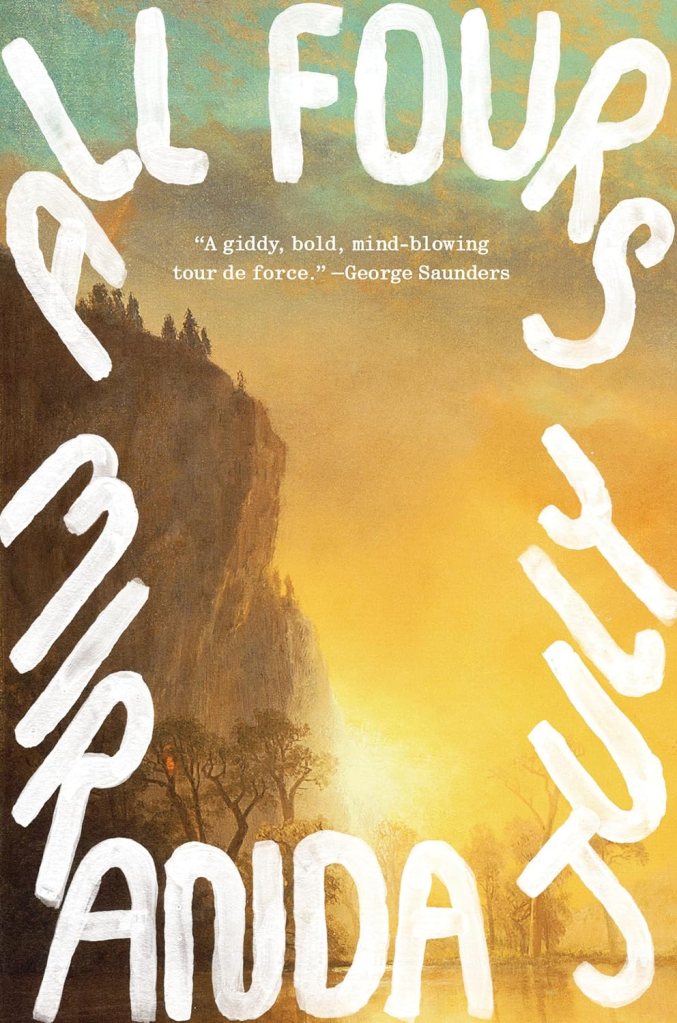
This was my experience reading Miranda July’s 2024 novel All Fours.
The first-person narrator is a 45 year-old, semi-famous artist. She and her husband have been together for 15 years, and share a six year-old child, who came into the world via a traumatic birth. The narrator, who lives in Los Angeles, has plans to visit New York. Having never taken a road trip, she decides to drive. She makes it all of 30 minutes outside of Los Angeles before holing up at a motel in Monrovia for two weeks, and setting the wheels in motion on a journey that will upend her relationships, her health, and her way of seeing the world.
I should now include a caveat that I have not seen/read/experienced any of July’s other work. There may be some other layers to opinions about this book (my own included) that are rooted in an understanding of her broader body of work, but I did not have that coloring my experience of this book — for better or for worse. (As overwhelming as this book was, I am almost inclined not to see her films or read her other stories at risk of damaging the surface tension of this story. But we’ll circle back to that.)
Back to the book. July does not hold back in her depictions of motherhood, of sex and sexual desire, of marriage. Many of her observations feel like thoughts we all think everyone else is having, but we are all too scared to say out loud. Reading them on the page, hearing them in July’s soft voice, felt like it was changing my life in real time. Raw snippets of conversation would be followed by a metaphor so breathtaking I was jealous I had never thought to describe a sky or a road that way — and then sad that I had never seen it that way — and then hopeful that I could.
All Fours feels like a spiritual successor to Sheila Heti’s How Should a Person Be and Chris Kraus’s I Love Dick. Stories of creative women approaching middle age, considering the significance of their relationships, their sexuality, their bodies, their minds. Small and insignificant interactions suddenly exploding with meaning. Kraus once referred to her work as occupying the sphere of “lonely girl phenomenology.” Many, many people hate these women and their stories.
From professional critics to the trenches of GoodReads, you will find declarative statements using words like “icky,” “annoying,” “narcissistic” being made in reference to these books. Many, thinking themselves clever, have proclaimed “these books have no point!” The only solution, therefore, must be the woman’s own insufferable self-obsession, leading her to create such a mindless and inconsequential product. Sometimes I mistakenly think feminism has made progress, and then I peek online to find the most ardent critiques of a book like All Fours have more to do with the narrator’s failings as a wife and mother.
There is power in these reactions, I suppose. They are in many ways tied to what makes All Fours so brilliant. It captures a feeling, a reality that so many people live with tightly coiled inside themselves. The reactions to the book prove why it must remain inside. Freedom + unfiltered self-expression + grotesque curiosity + uncertainty = bad and undesirable woman. Experiencing these feelings through the page is as close as many people get to living the lives they know they are capable of.
Though I felt seen line after line, I am decidedly not a 45 year-old, peri-menopausal mother. I am 31 years old and only beginning to grasp the outline of the next stage of my life. Reading the book felt like opening a tome of wisdom of women who came before me. “Here’s what to know” it says. “Now go ahead and don’t be afraid to live the life you want.”
There are still a few more weeks left of the year, and a few more books on my nightstand, but as of this post I read 55 books in the year of our Lord, 2023. This pace was largely made possible by the overarching reading theme of the year, which was decisively “graphic novels for cool queer teens.” But hey, if I can heal my inner child and get GoodReads cred at the same time, I’m gonna do it.
It was tough to whittle down what I read this year to a few favorites (I mean, I wanted to do a Top 5 list for a nice round number, and couldn’t even bring myself to do that) but I did my best. Here are the books that will stay with me long after 2023 has drawn to a close:
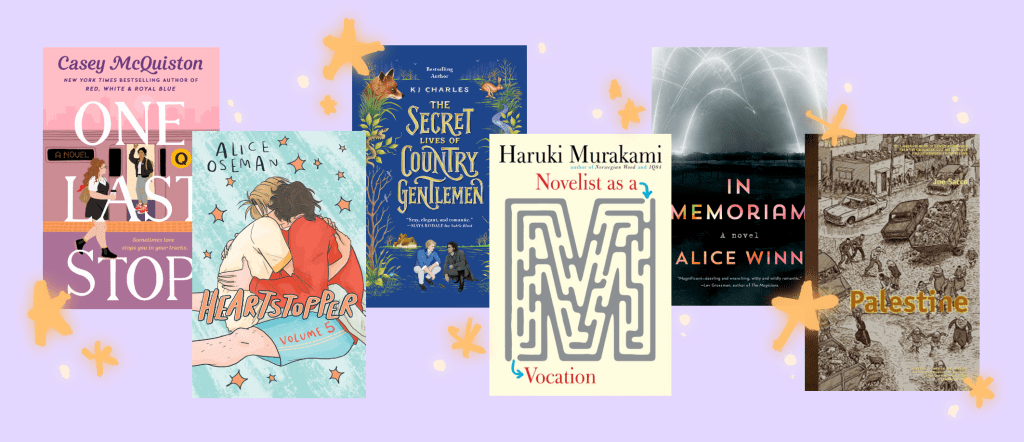
In Memoriam by Alice Winn
In Memoriam is most straightforwardly described as a gay love story set against the backdrop of World War I. Yet, that tagline seems an almost unfair reduction of the ways in which this story subverts expectations about the “war novel” and the “queer historical romance.” You will recoil in disgust at the visceral depictions of life in the trenches, you will grin at the warmth of friendship, and you will sob violently at the complex beauty of the love between the two main characters.
Palestine by Joe Sacco
With a genocide unfolding before our eyes in Palestine, taking the time to educate oneself is critical in the fight for liberation. While there are many excellent books on the history of Palestine and its occupation, none I read this year was more impactful than Joe Sacco’s graphic work of nonfiction. Edward Said puts it best in the introduction: “There’s no obvious spin, no easily discernible line of doctrine, […] no attempt to smooth out what is for the most part a meager, anxious existence of uncertainty[.]” Originally published in 1993, Sacco’s work just began printing once again.
Heartstopper (vol. 1-4) by Alice Oseman
I somehow missed the Heartstopper train when it left the station a few years back, but was blessed with the opportunity to hop on and become as obsessed as my fellow Tumblr Bisexuals earlier this year. Oseman masterfully depicts the realities of growing up queer, while always leaving more room for joy and friendship than pain. I don’t think it’s an exaggeration to say that this series provides both a safe place for kids who see themselves in Nick and Charlie (or any of the other incredible cast of characters), as well as a reparative space for adults, who were never able to immerse themselves in such a warm narrative.
The Secret Lives of Country Gentlemen by K.J. Charles
I don’t think there is a romance author more criminally underrated than K.J. Charles. After devouring everything she has ever penned late last year, I was thrilled by the release of The Secret Lives of Country Gentlemen in April. So thrilled, in fact, I forced my partner to listen to the audiobook with me during a road trip. But in further praise of the wonder of Charles — he was as hooked as I was. The protagonists, stuffy aristocrat Garth and roguish smuggler Joss, are *chef’s kiss*. What really sets the story apart, though, is the social/political/historical commentary that drives the characters and the narrative.
Novelist as a Vocation by Haruki Murakami
My thoughts on books about writing and Murakami’s recent works are similar: they are both bad. But when they are good? They transform me into a disciple who will proselytize about This One Book ad nauseum. Novelist as a Vocation is That One Book. Murakami peels back the curtain on his career and delves into the minutiae of his process. Selfishly, when writers write about writing, I want detail, I want clarity, I want a checklist of what someone eats for breakfast every day. This book gives all of that and more. I genuinely feel that reading this has made me a more thoughtful writer.
One Last Stop by Casey McQuiston
It’s not easy to explain how a story about an adrift young woman falling in love with a 1970’s punk who just happens to be stuck in time on the Q Train is one of the most loving, joyful books I have ever read — but I will do my best. McQuiston made my heart ache with nostalgia for an early 20’s spent in Brooklyn apartments cluttered with tchotchkes and quirky roommates, falling in love each time I set foot on the subway. The characters, which could so easily have fallen into caricature, are given individual and attention and development that brings them to life. The bond between the protagonists is real and palpable and earnest and radiates off the page. The book is a messy explosion of earnestness and love that made me want to be a better person. I don’t think it gets much better than that.
I don’t think I’ve ever pre-ordered a book as quickly as I pre-ordered The Woman in Me. I even tried to get my hands on an advance review copy (to no avail). For my sixth birthday, I was given a tape of …Baby One More Time, which instantly transformed me into a Britney mega-fan. Within a matter of weeks, I was a card-carrying member of the Official Britney Spears Fan Club (as in I literally had a card in my Velcro wallet). There was a life-sized Britney poster on the back of my bedroom door that greeted me each day. Each time Britney released a new music video, I purchased the accompanying doll that would sing the chorus of the single when you pressed on her silver belly-button ring. You get the idea.
As a teenager and adult, my childhood obsession waned into a more distant reverence for the artist that shaped me. Then, as a law student, I found myself face-to-face with Spears once again: as a clinical student in a civil litigation clinic, I worked with individuals who were looking to free themselves from guardianships, at the same time Spears was working to free herself from hers.
For 13 years, one of the most successful entertainers of all time was subject to a legal conservatorship. From 2008 to 2021, Britney Spears’ father controlled her money, her healthcare, and her relationships — while pocketing millions of dollars each year for himself. As the realities of this control became more public, Spears’s fans formed the #FreeBritney movement and engaged in a highly-publicized rallying cry to grant the artist her independence.
Since freeing herself from the conservatorship, Spears has been on a complex healing journey. Her intertwined feelings of anger, betrayal, liberation, and contentment are often chronicled in lengthy Instagram posts, accompanied by videos of her dancing in her home, or trying on different outfits. The posts are not always straightforward (and when is healing ever linear?), causing some to question Spears’s wellbeing. In early 2023, concerned “fans” requested a welfare check to Spears’s home, resulting in a police presence and a subsequent plea from Spears to respect her privacy. These incidents create an ever-present sense that, though she is technically free, she is forever at risk of being re-victimized by the legal system that held her captive for more than a decade.
With the neverending vortex of narratives swirling around her existence, Spears announced her memoir in July of 2023. The publisher describing the “groundbreaking” book as “illuminat[ing] the enduring power of music and love–and the importance of a woman telling her own story, on her own terms, at last.”
On October 24, 2023, the day of its publication, I opened the cover of my freshly-pressed copy of The Woman in Me with high expectations. Immediately, I was struck. Spears opens the memoir with a prologue, reflecting on times as a child when she would escape the chaos of her family home for the nearby woods. There, Spears reflects, she felt peace — she felt God. This search for stillness amidst the chaos is a defining theme of the book. From a childhood spent bouncing between cities and jobs, quite literally feeding her family, to an adulthood sequestered at home so as to avoid the paparazzi, we see the ways in which Spears is so rarely given the opportunity to focus on her own needs.
As a writer, Spears’s storytelling style is fluid and conversational. At times, I felt like I could imagine Spears sitting at lunch with a friend, or even reclined on a therapist’s sofa, describing the heartbreak of a failed relationship, or the grueling schedule of a world tour. Narratively, this can make timelines difficult to follow. There are chapters that oscillate in time, discussing the era surrounding one album and then hopping back to the one prior. More than once I found myself flipping back a few pages to make sure I hadn’t missed a transition or a reference to a date only to realize there was none. Reflecting on the book as a whole, though, I see how the memoir is not meant to be a linear narrative, but a reflection on a life defined by the tensions between freedom and control.
While the lead-up to the book’s release focused largely on revelations about Spears’s relationship with Justin Timberlake, one of the key motivations for the existence of the book itself was the conservatorship. Accordingly, the final third or so of the book focuses on the reality she faced for 13 years: no access to her own money, guards controlling her every move, medications forced into her body to make her compliant.
Then, as swiftly as the conservatorship was imposed, Spears references its end. The book draws to a brisk close in a way that left me imagining the narrator, at lunch or on the couch, was trying to quickly wrap things up and get on with their day. I noticed a similar urge at other inflection points in the book, such as which Spears famously shaved her head while the paparazzi photographed her from outside the salon. Spears’s description of that turbulent time in her life leaves much clearly lurking under the surface, while readers are given clipped justifications.
This tendency in the book left me deeply conflicted, both by the writing itself and even moreso by my response to it. Spears’s memoir explores the control and manipulation she has been subject to her entire life; being observed and picked apart to the point where it broke her. The book is, in this way, a contradiction: a tell-all memoir that at its core really tells the reader that the world is not owed a full explanation. Yet, as a reader, I found myself doing exactly that: wanting more details, more exposition, more of everything. It was an opportunity, albeit an uncomfortable one, to examine why I felt that sense of entitlement.
From a literary standpoint, there are flaws in this book. Repetition, odd editing, choices to fixate on throwaway observations in favor of depth and detail. And yet. The Woman in Me triumphs over any critique because of the simple fact that it does exactly what it set out to do: tell Britney Spears’s story in her own words.