• My 2025 in Books

    This year, I read 52 books.

    The books overlapped and intersected with each other, but somehow tidily added up to one book a week.

    Searching for themes, it’s easy to see my grief for my cat, Torby, processed in book form. I lost her just as 2025 began, and found comfort in every cat-related piece of media I could get my hands on. The Traveling Cat Chronicles by Hiro Arikawa is easily my favorite book I read this year, and I will always be so grateful that it was there for me when I needed it.

    2025 was also the year I grew my Japanese studies beyond manga and began reading novels (for grown-ups!). キッチン by Banana Yoshimoto is one of my favorite books in English, and I loved reading it all the more in its original form. Yes, I still read plenty of manga — including the first nine volumes of ナナ as part of an online book club with fellow language-learners.

    One of the most unexpected favorites of 2025 was Kelly Bishop’s memoir, The Third Gilmore Girl. I understand why she chose to title the book as she did, but Bishop’s story — and her storytelling — transcend the label. Her raw stories of life as a dancer in 1970’s New York City have more in common with Just Kids than the fluff of Bishop’s Gilmore Girls co-star Lauren Graham’s Talking as Fast as I Can.

    Stray Observations:

    • I read Honey by Isabel Banta in a single sitting while camping earlier this year. I can’t remember the last time I did that!
    • The excitement surrounding Heated Rivalry honestly sustained me during a tough end to this year. I adore the show and the books are equally as brilliant.
    • It’s rare for me to downright hate a book. Don’t get me wrong, there are times when I love to be a hater. But when it comes to literature I try to be as open-minded and curious as possible. The books in the “not for me” category are books that I did not enjoy reading, but that I respect nevertheless. The books in the “kindling” category are genuine abominations.

    What Will I Read Next Year?

    Middlemarch. Mostly so I can stop talking about how I need to read Middlemarch.

    . . .

  • The State of My Nightstand

    A stack of books on a nightstand, with a water bottle next to the stack.
    • 矢沢あいの「ナナ」v2 | “Nana” vol. 2 by Ai Yazawa
      • It’s difficult for me to write about “Nana” because the series has shaped me more than any other book, movie, tv show, album. I have long said I will write some definitive piece about the series, but can never actually bring myself to do so. In the meantime, I am re-reading the series as part of a virtual book club and enjoying every moment.
    • 角野 栄子 の 「魔女の宅急便」| “Kiki’s Delivery Service” by Eiko Kadono
      • Kiki’s Delivery Service may well be my favorite film by one of my favorite directors, so of course I had to read the book that inspired the movie. My Japanese is at a level where enjoying middle-grade literature is no problem — yet this book has proven extremely challenging. It’s full of slang and dialect that’s hard to parse on the page. As a result, what should be a fun and light read has taken me now more than 6 months to slog through.
    • あずまきよひこの「よつばと!」v16 ”Yotsuba” vol. 16 by Kiyohiko Azuma
    • The Legend of Meneka” by Kritika H. Rao
    • Fifty Sounds” by Polly Barton
      • Barton is one of my favorite translators of Japanese to English, so I was very happy to come across this book at the library. Part memoir, part theory, part unnecessary references to Kierkegaard. Though I am not sure I am actively enjoying this book, I am glad it crossed my path.
    • If Only” by Vigdis Hjorth
      • I am captivated by this extremely strange novel. I was previously unfamiliar with Hjorth, but quickly became interested when the book jacket touted her as the “Nordic Annie Ernaux.”
    • Bralette Zine vol. 1
      • I bought this zine on a whim when I stopped in to the lovely Print Bookstore in Portland, Maine. It’s delightful!
    • This is How You Lose the Time War” by Amal El-Mohtar and Max Gladstone
      • I need to rectify my status as “the only person who hasn’t read this.”
    • The Goodbye Cat” by Hiro Arikawa
    • 青木美沙子の 「まっすぐロリータ道」| “I’ll Always be a Lolita” by Misako Aoki
    • The Song of Achilles” by Madeline Miller
      • Again, am I the only person who hasn’t read this? I’ve been contemplating doing a “summer reading list” like we used to do in school, and I think this would be at the top of the list.
    • Read Real Japanese” edited by Michael Emmerich
    • Light in Gaza” edited by Jehad Abusalim, Jennifer Bing, and Mike Merryman-Lotze
    • The Artist’s Way” by Julia Cameron
      • I committed to The Artist’s Way program last year, but fell off about halfway through. I think it’s a wonderful, generative, and restorative exercise. This is languishing on my nightstand as a reminder that I should give it another go.
    • クッキー雑誌2024年11月刊 | Cookie Magazine, November 2024 Edition

    Am I actively reading all of these books? No. Is it comforting to know that certain books are just a stretch away at any given moment? Yes.

    . . .

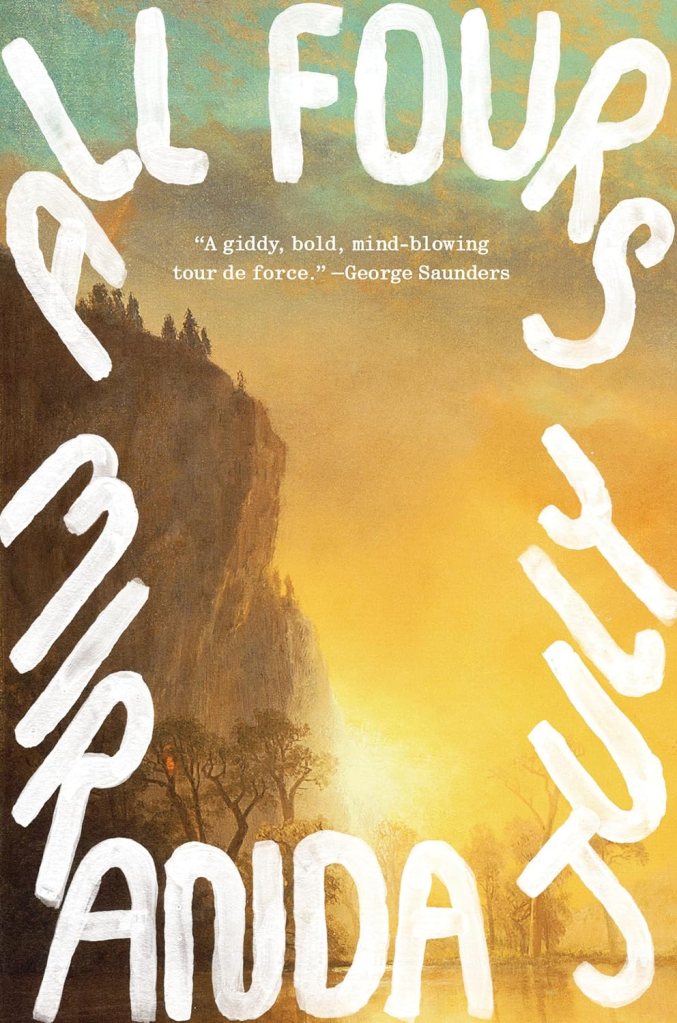
  • “All Fours” by Miranda July

    Sometimes a book comes to you at exactly the right moment in your life. At first, you think it must be a fluke; certainly there will be a fork in the story where the plot deviates from your own reality. But then, sentence after sentence continues to feel like it was constructed personally with your own world in mind. This is a rare experience, and one that should be treasured.

    This was my experience reading Miranda July’s 2024 novel All Fours.

    The first-person narrator is a 45 year-old, semi-famous artist. She and her husband have been together for 15 years, and share a six year-old child, who came into the world via a traumatic birth. The narrator, who lives in Los Angeles, has plans to visit New York. Having never taken a road trip, she decides to drive. She makes it all of 30 minutes outside of Los Angeles before holing up at a motel in Monrovia for two weeks, and setting the wheels in motion on a journey that will upend her relationships, her health, and her way of seeing the world.

    I should now include a caveat that I have not seen/read/experienced any of July’s other work. There may be some other layers to opinions about this book (my own included) that are rooted in an understanding of her broader body of work, but I did not have that coloring my experience of this book — for better or for worse. (As overwhelming as this book was, I am almost inclined not to see her films or read her other stories at risk of damaging the surface tension of this story. But we’ll circle back to that.)

    Back to the book. July does not hold back in her depictions of motherhood, of sex and sexual desire, of marriage. Many of her observations feel like thoughts we all think everyone else is having, but we are all too scared to say out loud. Reading them on the page, hearing them in July’s soft voice, felt like it was changing my life in real time. Raw snippets of conversation would be followed by a metaphor so breathtaking I was jealous I had never thought to describe a sky or a road that way — and then sad that I had never seen it that way — and then hopeful that I could.

    All Fours feels like a spiritual successor to Sheila Heti’s How Should a Person Be and Chris Kraus’s I Love Dick. Stories of creative women approaching middle age, considering the significance of their relationships, their sexuality, their bodies, their minds. Small and insignificant interactions suddenly exploding with meaning. Kraus once referred to her work as occupying the sphere of “lonely girl phenomenology.” Many, many people hate these women and their stories.

    From professional critics to the trenches of GoodReads, you will find declarative statements using words like “icky,” “annoying,” “narcissistic” being made in reference to these books. Many, thinking themselves clever, have proclaimed “these books have no point!” The only solution, therefore, must be the woman’s own insufferable self-obsession, leading her to create such a mindless and inconsequential product. Sometimes I mistakenly think feminism has made progress, and then I peek online to find the most ardent critiques of a book like All Fours have more to do with the narrator’s failings as a wife and mother.

    There is power in these reactions, I suppose. They are in many ways tied to what makes All Fours so brilliant. It captures a feeling, a reality that so many people live with tightly coiled inside themselves. The reactions to the book prove why it must remain inside. Freedom + unfiltered self-expression + grotesque curiosity + uncertainty = bad and undesirable woman. Experiencing these feelings through the page is as close as many people get to living the lives they know they are capable of.

    Though I felt seen line after line, I am decidedly not a 45 year-old, peri-menopausal mother. I am 31 years old and only beginning to grasp the outline of the next stage of my life. Reading the book felt like opening a tome of wisdom of women who came before me. “Here’s what to know” it says. “Now go ahead and don’t be afraid to live the life you want.”

    . . .