• Free Knitting Pattern: 21st Century Austen Heroine

    INTRO

    May this bonnet be a testament to the fact that necessity breeds innovation. After I was struck with a powerful urge to knit a chapeau of this style, a search led me to the realization that no such pattern exists (for adults anyway…per usual, my desired mode of dress is reserved for humans under 2 years old). 

    Well, I thought, time to brush off my patternmaking skills and put together the hat of my dreams. After a few attempts, I developed “21st Century Austen Heroine” so named after the fact that it is both romantic and a little odd – just like my favorite characters.

    The bonnet can be worn fastened for an elegant look, or untied for an effortlessly cool vibe. While I chose a neutral shade to match my winter wear, I think this would look equally incredible in a vibrant shade. 

    However you decide to rock your bonnet, may your chilly days be filled with wit, warmth, and love! ♡

    MATERIALS

    • Size 3 circular needles
    • Size 3 straight needles
    • Approximately 275 yards of fingering weight yarn
      • I used Diamond Laine Elmer in the colorway “Cashew”
      • Shout out to “The Lamb & Kid” on Bainbridge Island, WA, where I purchased this yarn. It’s one of the most beautiful fiber shops I’ve ever been to!

    GAUGE + FINISHED DIMENSIONS

    1” wide = 5 ½ stitches

    1” tall = 8 stitches

    THE PATTERN

    BACK OF THE HEAD

    Cast on 33 stitches. 

    Row 1: Slip 1 stitch, knit 32 stitches.

    Row 2: Slip 1 stitch, purl 32 stitches.

    Repeat Rows 1 & 2 until your piece measures roughly 9” long, unstretched. 

    Cut the working yarn. 

    SHAPING THE HEAD

    You will now begin shaping the crown of the head. To do this, you will pick up and knit the sides of your piece, and continue knitting back and forth. If you have ever knit a sock, this stage is going to look very similar to picking up the heel flap. If you haven’t knit a sock, ignore me and forge on! 

    With the right side of the fabric facing you, use one of your straight needles to pick up 33 stitches alongside the left edge of your piece. 

    Then, use another straight needle to pick up 33 stitches along the right edge of your piece. 

    You should now have a total of 99 stitches across your three needles. You can continue working across three needles, or move all stitches back to the circular needle (it might be a little tight at first, so you may want to work a few rows across three needles before transferring). 

    Row 1: With the RS of the fabric facing you, knit across all 99 stitches.

    Row 2: With the WS of the fabric facing you, purl across all 99 stitches.

    Gradually, you will see the crown of the head begin to take shape. 

    Continue knitting Rows 1 & 2 until the piece measures approximately 9.5 inches tall, and – when laid flat and folded in half – 7.5 inches across at its widest point. 

    End on a RS row. 

    For a larger, deeper bonnet, you can continue knitting, but you will want to stop approximately 1 inch less than your desired length. 

    FINISHING THE HEAD

    You will now create the garter stitch edging on the front of the bonnet.

    Row 1: With WS of the fabric facing, knit all stitches.

    Row 2: With RS of the fabric facing, knit all stitches.

    Rows 3, 5, 7, 9: Repeat Row 1.

    Rows 4, 6, 8: Repeat Row 2. 

    Row 10: Cast off using your preferred method. I used the “Jenny’s Surprisingly Stretchy Bind-Off” method, but any bind-off will do. 

    Cut the working yarn.

    ADDING THE TIES

    You will now add the bottom brim of the hat and the ties in one fell swoop!

    Row 1: Using your circular needle, cast on 75 stitches.

    Then, with the RS of the hat facing you, pick up the bottom edge of the hat. The size of the hat will dictate just how many stitches you pick up. Using my gauge and dimensions, I picked up a total of 78 stitches. The most important thing here is to ensure you pick up an even number of stitches on both sides of the hat, with the back of the hat as the midpoint. 

    After you have picked up the bottom edge of the hat, cast on an additional 75 stitches.

    Your circular needle should now have a total of 228 stitches ready to knit.

    Row 2: With WS of the fabric facing, knit all stitches.

    Row 3: With RS of the fabric facing, knit all stitches. 

    Rows 4, 6, 8, 10: With WS of the fabric facing, knit all stitches.

    Rows 5, 7, 9: With RS of the fabric facing, knit all stitches. 

    Row 11: Cast off using your preferred method. I used the “Jenny’s Surprisingly Stretchy Bind-Off” method, but any bind-off will do. 

    Cut yarn and weave in all ends. 

    Go forth and be fabulous!
    . . .

  • Blocking Knitting In A Small Apartment

    www.ideas4homes.com

    It’s no surprise that blocking is considered an integral part of the knitting process. Those who choose not to block are missing out on a life of even stitches, soft and squishy fabric, and even hemlines. (But that’s another story altogether.)

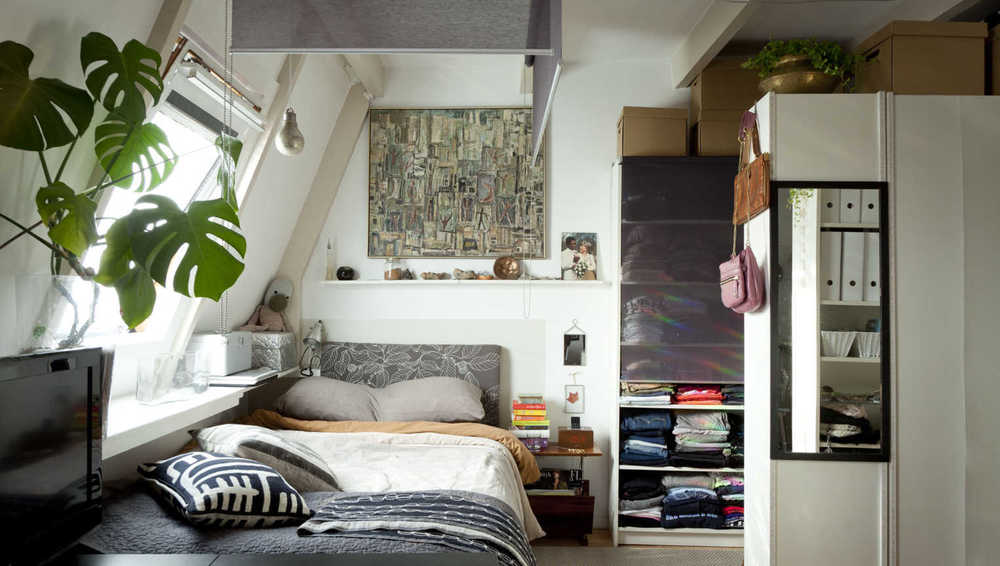
    It would be truly ideal if we all lived in homes with an exclusive knitting room where we could spread out a giant blocking board and lay out ten shawls at a time. Unfortunately, some of us live in New York City apartments where available floor space is a laughable concept. 

    If you don’t have much room to dedicate to the art of blocking–whether you find yourself in a dorm room, community space, or the aforementioned East Village studio–don’t fear! Years of cramped quarters have led me to the development of a small-scale blocking regimen. Here’s my tips:

    Soaking

    Leaving my pieces in an industrial ten-gallon bucket in the basement? Yeah, not going to happen. Believe it or not, I soak my knitting in a pasta pot. Bigger projects tend to protrude out of the pot, so this method requires some stirring/monitoring in order to make sure all parts of the piece get equal attention. Oh, and make sure you don’t turn on the stove.

    I also use Soak Wash products in order to maximize my blocking results. I plan on doing a more comprehensive review of their products in the future, but for now let me just say: worth it. 

    Pinning

    In order to save space, I don’t use any kind of blocking board. Instead, I use a yoga mat. It’s surprisingly perfect when it comes to fitting into tight corners or sliding from one corner of the apartment to another. And of course, when the blocking is all done, the mat rolls right up and stashes away. (What? You thought I was exercising?) 

    It very well may just be me, but I find that I am constantly losing all kinds of pins in the blocking process. When you’re blocking in a small and high-trafficked area, a rogue T-pin is the last thing anyone wants to discover. To solve this, I bought a set of Knitter’s Pride Blockers. The large size minimizes how many pins you need (one set works completely for an entire sweater), and they work wonderfully with a squishy yoga mat. 

    Drying

    One concern I really had about blocking in an apartment was potential pests. Bugs love moisture and the idea of having a wet sweater laying on my floor for a few days freaked me out to the max. But I’ve come to minimize the excess moisture with the use of a bath towel places in between the projects and the yoga mat. This helps keep moisture at bay. 

    Furthermore, if you are able to place the project in indirect sunlight, near a fan, or near an open window, the drying process will be pleasantly expedited and you can stop searching exterminator reviews on Yelp. 

    Where to Block?

    With all of this in mind, you’re ready to compactly block like a pro. But one question does remain–where can I actually block when my floor space is so limited? Here are a few places I have made magic happen:

    Under a kitchen table, under the bed, in the bathtub, on a kitchen counter, inside a storage unit, on top of a bookshelf, on a shelf of the aforementioned bookshelf, on the roof (on a hot day)…

    Anywhere there is space, it is yours to use! 

    Remember, blocking doesn’t have to be glamorous, because your knits will be glamorous afterwards.

    xoxo

    . . .

  • Recent Project Extravaganza!

    I’ve been on a serious knitting spree this summer. Kind of contradictory, I know–who wants to hold five pounds of wool in their lap on a 95 degree day? Still, this summer I’ve wrapped up tons of long-overdue projects and whipped up a couple of new ones. 

    From top to bottom: Bundled in Brioche by Stephen West, an original pattern I’ll be sharing soon!,  Viajante by Martina Behm, a random bastardized DROPS pattern I have never been able to find again, and Women’s Cardigan Style No. 150 from Free Vintage Knitting

    Currently on my needles: Ladies Classic Raglan Pullover by Jane Richmond in Cascade 220 (the color scheme is Neapolitan Ice Cream, of course), and a pair of rainbow socks in Manos del Uruguay fingering weight for my niece. 

    I’ll have more new patterns coming your way soon! 

    xoxo

    . . .

  • Favorite Yarn: Araucania Huasco

    Image: earthfaire.com

    Oh yeah, this blog is about knitting too, right? Well let’s talk yarn!

    I’ve had a skein of Araucania Huasco Botany Lace sitting around in my stash for at least two years. As with any great skein, I bought it because it was just so damn pretty–a beautiful kettle-dyed mix of blues and greys. Yet, being a fingering weight, I have resisted using it because I either can’t decide on a project or don’t feel like self-inflicting carpal tunnel with #1 needles that day. 

    Finally, after completing a ginormous sweater for Rhinebeck (that can only be described as Bjorkian) I wanted to do something small-scale with a bit of intricacies. I pulled out my Araucania, some #4’s, and cast on for a hat. 

    I am literally addicted to knitting with this yarn right now–which doesn’t bode very well considering it’s finals week and I’d rather make a hat and watch Sailor Moon. The texture of the yarn is squishy, never stringy, and the variegation in color is oh-so subtle. The best part: the stitch consistently is really beautiful. I’m working the honeycomb stitch in the round and the results have been really even and lovely. 

    This would be a seriously rad yarn for a sweater or bigger project (if you have the patience…pshhhh). I can’t even imagine these colors on a large scale! The yarn is delicate and it’s advised to be dry-cleaned, so I wouldn’t suggest socks despite how good they would feel. I think scarves, shawls, hats, and other down the middle projects would be made really special with this yarn.

    Have you knit with Araucania before? I’d love to hear your thoughts!

    xoxo

    Shop Araucania Yarns at KnittingFever.com


    . . .

  • Knit for Charity

    The Penguin Foundation

    It’s time to put your needles and hooks to work!

    A handmade item has incredible power to brighten and benefit someone’s life in unimaginable ways.

    Below is a list (sorted alphabetically) of awesome organizations that need your knitting skills to make a difference! Please contribute to this list by adding your favorite organization in the comments section.

    Afghans for Afghans // “humanitarian and educational people-to-people project that sends hand-knit and crocheted blankets and sweaters, vests, hats, mittens, and socks to the beleaguered people of Afghanistan.”

    Binky Patrol // “We are an all volunteer, national, non-profit organization making and distributing homemade blankets to children born HIV+, drug-addicted, infected with AIDS or other chronic & terminal illnesses, those who are abused, in foster care or experiencing trauma of any kind. Our recipients are from 0-18.”

    Chemocaps // “We are knitting and donating hand knit chemo caps to wonderful hospital oncology inpatient units and hospice programs so that cancer patients who lose their hair can have a very soft hand knit cap to call their own to comfort their heads and their souls because they will know someone cared enough to knit a cap for them.”

    Hats 4 the Homeless // “If you know how to crochet or knit or would like to just donate a hat, scarf or pair of gloves…The warm gift-giving feeling that comes with giving this gift will surpass any other gift you give this Holiday season.”

    Knit-a-Square // “Together we work hard to help warm and comfort the children and we’d greatly value your contribution to this knitting project for the AIDS orphans of southern Africa. We ask the world’s knitters and crocheters to send 8″/20 cm squares to South Africa, where we have them sewn into blankets for the children.”

    Penguin Foundation // “Knitted penguin jumpers play an important role in saving little penguins affected by oil pollution. A patch of oil the size of a thumb nail can kill a little penguin. Oiled penguins often die from exposure and starvation. Oil separates and mats feathers, allowing water to get in which makes a penguin very cold, heavy and less able to successfully hunt for food.”

    Snuggles Project // “After being given a Snuggle, a frightened and/or difficult to handle animal is able to become calm. This calming effect gives the animal and the caregiver time to learn how to handle the situation. We believe that this calming effect has saved the lives of many newly-sheltered animals.”

    Wrapped in Love // “To help families in time of need during palliative care with homemade blankets and items made with love.”

    xoxo

    . . .