“Yesterday, we handed our written list of demands to the university. I don’t think I will ever forget how I felt, printing off the documents and running together to the Student Support Office with them tightly clutched in our arms” – Yuka, Former Steering Committee Member, University of Tokyo Palestine Solidarity Encampment
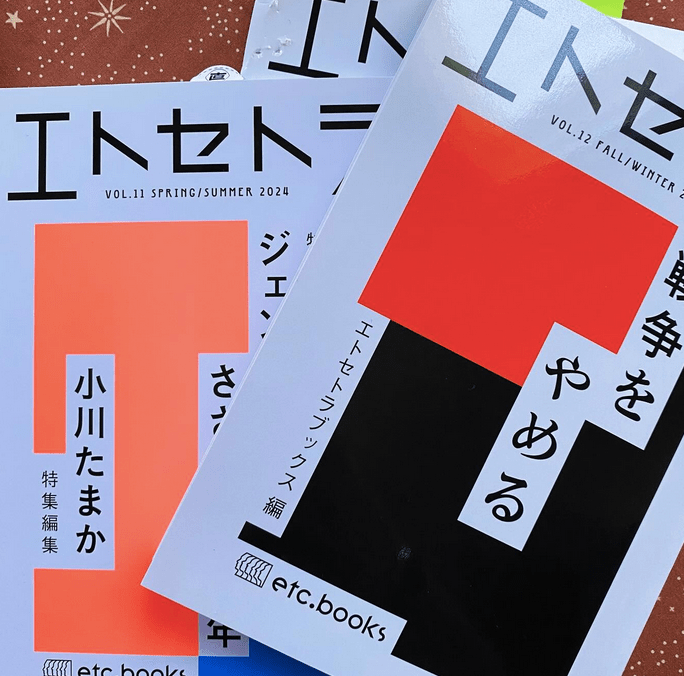
Thank you so much to the brilliant editorial team at Spectre Journal for publishing my latest: a translation of a Palestine Solidarity Encampment Diary, originally published in Etc. When I first read the piece, I was so captivated by Yuka’s relentless dedication to women and queer activists, and her necessary interrogation of misogyny and homophobia in student activist spaces. It’s a story I think that anyone who has ever been involved in student organizing can see a little of themselves in.
Etc. Books チーム、ありがとうございました!数年前から、大ファンです。Etc雑誌は本当に重要なな仕事をしていて、一緒にコラボする機会があったことをとても嬉しく思います。ゆかさんの言葉は私の頭にいつも響いています。
Last month, I went to Japan for 12 days. It was the second time I have been there; the first with my husband. I had therapy the day before the trip and after I was done agonizing over all of the ways in which I could tragically die in a plane crash, I spent the remainder of the session agonizing over the trip itself. “I know I am putting too much pressure on the trip to be perfect,” I explained. I was expecting it to change me somehow, to fulfill me, to validate me. Not only in a cosmic sense, but more concretely, too. I have spent the last five years studying Japanese on a daily basis, and what remaining free time I have is more often than not occupied by watching lifestyle vlogs of people living in Japan. Many of them are ex-pats from somewhere or another who have charming Tokyo apartments, loving partners, and meaningful communities surrounding them. I often find myself fantasizing about what my life could look like, were I choose to replace the streets of Cambridge with those of Shibuya.
My premonition proved almost immediately true. Forty-eight hours after landing at Narita, I was an anxious mess. This may be partially attributable to jet lag, sure, but there was also a sense of desperation. A desire to prove myself, to fit in with the culture, to be the “best” visitor. So good, in fact, I might even be mistaken for a local. My hours of research and cultural consumption informed the way I stood on the train, the way I handled myself in cafes, the way I put together my outfits.
This posturing stemmed from a fear that kept me from ever fully enjoying myself, except in fleeting, private moments. Countless times I turned away from a shop or a restaurant or an experience because I could not handle the self-imposed pressure that came with continuing that performance for another moment.
Prior to our trip, my husband briefly attempted some Duolingo lessons, but never got much further than “arigatou gozaimasu.” Before leaving home, I was giddy at the prospect of serving as our linguistic envoy. Another opportunity to prove my worth! Perhaps unsurprisingly, this task quickly spiraled into self-doubt. I was not only my own face, but the face of a unit; accountable for both of us. I found myself saying things in urgent, hushed tones like “you’re not supposed to leave your chopsticks in your rice.”
Despite this, it was my husband who ended up having more meaningful conversations with thrift-store shopkeepers, old women in elevators, and bartenders. Those conversations were in English, of course, but they were connections nevertheless. My most memorable dialogues include a taxi driver’s detailed explanation of the various tolls we’d be subjected to should we take the highway to our destination.
Throughout the trip, as I prowled Google Maps in search of places to eat, I came across many cozy-looking izakayas, any of which I would have loved to try. Peeking at the reviews, I found numerous English comments — almost all of them American men — who raved about the food, about the “experience,” about how they “came across this little hole in the wall while walking around by my hotel and decided to pop in. I don’t speak a lick of Japanese, but the owner was very patient with me and did their best to explain various dishes. I don’t know half of what I ate, but it was hands down the best meal of my entire trip!” If I go eat there, I thought, what am I but another Chad or Brad or Kevin, inserting myself into a situation with no regard for others?
One night, this resulted in such significant anxiety that I found myself uncontrollably crying on a Kyoto side street, for all the fluffy dogs in strollers to see. The solution was to go to a nearby grocery store and take food back to my lodgings, where I could eat pre-packaged yakisoba in silence.
Another day, hanging from a strap on the Tokyo Metro, I found myself reading Walker Percy’s essay “The Loss of the Creature,” an oft-referenced text for the disillusioned traveler. In the essay, he describes a tourist’s interaction with their new surroundings as “an anxious love,” because “they are afraid that at any moment it might fail them.” The place and people that they have spent so much time preemptively fawning over, the expectations they have labored away at building up, might come crashing down in an uncomfortable reality that a place is just a place. My experience was the inverse: I was so paranoid at disappointing others, so certain that I would disappoint myself, that I was ultimately barred from having genuine experiences. So fearful was I of coming across as an obnoxious tourist, that I spent nearly two weeks manifesting the bored indifference of a local. And do I think this actually fooled anyone? By working to exude the aroma of “bored indifference” I merely internally experienced the sensations of “bored” and “indifferent.”
There is an obvious fallacy in this behavior. The self-imposed rules and anxieties with which I strapped myself had to come from somewhere, right? My attempts to blend in conjured up a host of symbols and principles that I have spent years internalizing from a range of sources — but none of them from actually experiencing life as a resident of Tokyo or Osaka or Kyoto. This approach is not unlike a scenario described in Percy’s aforementioned essay. He describes a young man sitting in a French cafe who is positively titillated, having just witnessed a brawl: “For the young man is actually barred from a direct encounter with anything French excepting only that which has been set forth, authenticated by Puccini and Rolland-those who know. If he had encountered the restaurant scene without reading Hemingway, without knowing that the performance was so typically, charmingly French, he would not have been delighted. He would only have been anxious at seeing things get so out of hand. The source of his delight is the sanction of those who know.”
And what am I but a reader of Haruki Murakami? A wearer of Rei Kawakubo? A viewer of Ryusuke Hamaguchi? A listener of Ryo Fukui? That is not to say these are not worthwhile artists to engage with — but for me, as a visitor, they are also sources, subconsciously informing who I should be. On this, Percy cites Kierkegaard: “Once a person is seen as a specimen of a race or a species, at that very moment he ceases to be an individual. Then there are no more individuals but only specimens.”
By flattening myself to these preconceived notions, I was ultimately flattening the place which I was attempting to experience and therefore negating any and all attempts to embody the most “enlightened” traveler possible.
Friends and family and colleagues have asked me about my trip and I struggle to respond. I can truthfully say “it was incredible,” but I find myself resisting the urge to sum up experiences into postcard-shaped bites. I fear coming off as garish and entitled if I were to describe the exquisite architecture of a Buddhist temple, or the historical underpinnings of Harajuku street fashion. What am I gaining from this? What am I depriving myself of from this?
Agnes Callard’s thought-provoking essay “The Case Against Travel,” argues that the issue with travel is our expectations that we will leave changed – and what transformation, after all, is bound to happen in the span of a few days, a few museums, a few new restaurants, etc?
But here I am, changed. Not in the way Callard was referring to, I think. I don’t feel some grand and cosmic connection to the universe; a reminder that we are all humans walking life’s path and so forth. What is the opposite of worldly? That is how I feel. I feel too strangely connected to myself and too uncomfortably aware of all that entails.


 Katie Fustich