Until this summer, I had never lived in an apartment with its own washer and dryer.
Prior to July, washing my clothes (and, with disturbing infrequency, bed sheets) meant layers of strategic planning. Sometimes it meant hauling a wire cart, stuffed with sacks of musty bras, three blocks down Myrtle Avenue, to the nearest laundromat. Other times it meant descending into a basement whose rat population was kept at bay by a friendly three-legged cat.
As of this summer, I can separate my white socks from my black sweaters with no regard for the number of quarters in my possession. I don’t have to pretend my dishtowels don’t vaguely smell of mildew at all times; I can simply toss them in the hamper, where they will await a timely cleaning, and then pull out a fresh one from a kitchen drawer.
Having laundry to do, mums to water, and dishwasher filters to clean is glorious — luxurious even. It’s also so normal in a way that’s hypnotizing.
I see how folding fresh clothes and preparing a week’s worth of lunches into neatly-stacked Pyrex containers can be the stuff of a life, with Love is Blind episodes to fill the space in between. The days feel full enough to send you to bed tired. Add in a regular gym regimen and maybe one social interaction per week and your calendar is booked and busy as can be.
There is no rhythm to my writing lately. Creativity comes in fits and starts. I have a box of pastels next to the couch, poised. My writing notebook is tucked under the laptop I use for work. Everything is ready for me, but suddenly there is far too much laundry to do.
There are many people who would rather have their lives be comfortable than interesting, and both qualities cannot always coexist. I once heard someone say that, in order to be a powerful, creative woman, you also have to let your house be a little messy. Dust needs to gather in the corners of your house, or else it will gather in the corners of your soul.
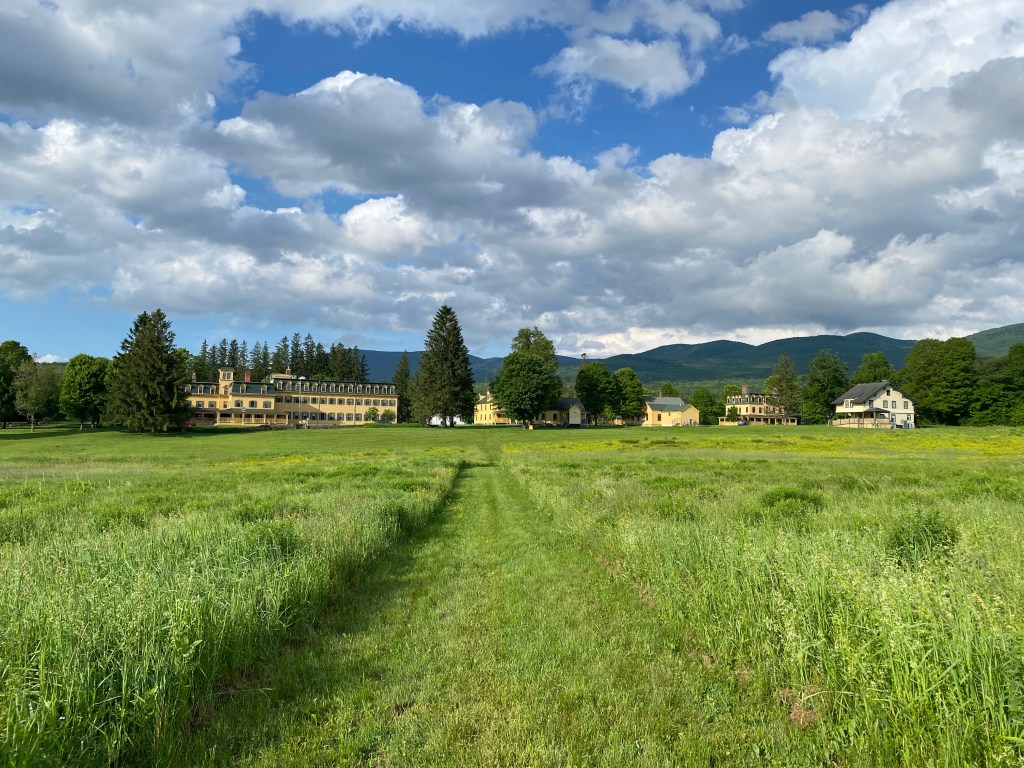
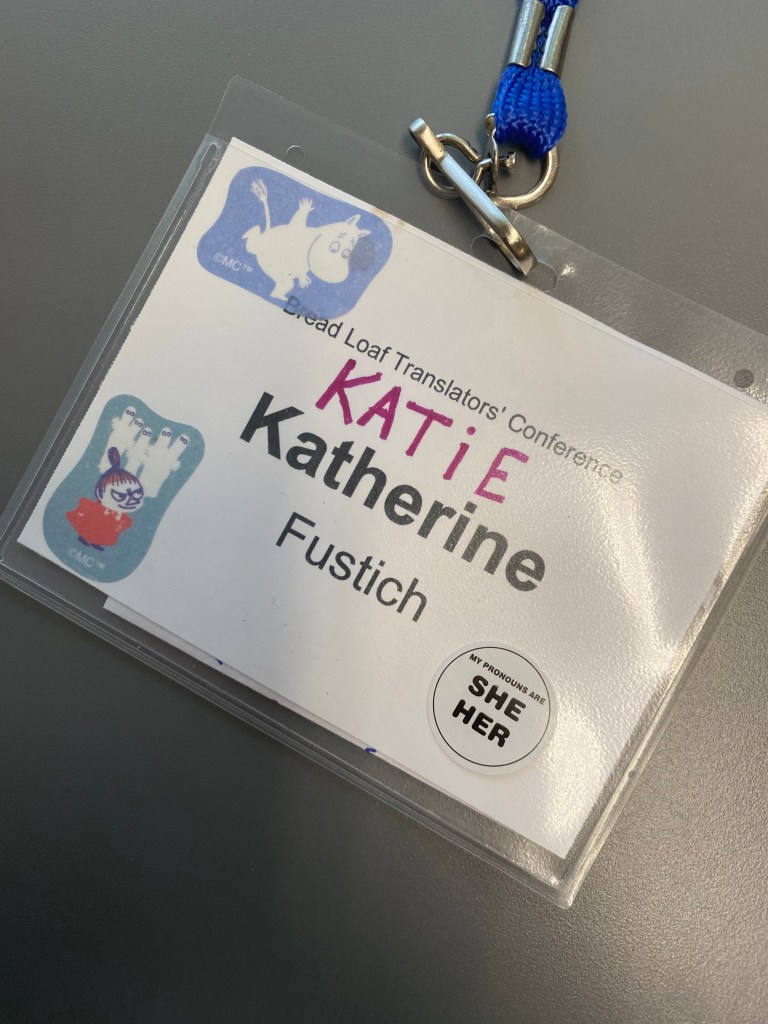
Last month, I attended the Bread Loaf Translators’ Conference. In the days before, I was so nervous. “What if the other kids don’t like me?” I wondered.
Those fears didn’t matter, in the end. A different version of myself came back down from that mountain.
Surrounding myself with others who believe that reading and writing are the most beautiful stars in life’s constellation was indescribably affirming.
Singing Alanis Morrissette at karaoke night was almost as affirming.
What is the opposite of gatekeeping? Knowledge sharing? Whatever it is, it’s so refreshing; so needed. I understand the desire for mystique, but I think generosity builds legends in just the same way.
I bought my husband a Bread Loaf t-shirt. He wore it out to dinner the day after I got back. A woman leaving the restaurant looked at him and said “Bread Loaf! Wow!” She met my gaze as if to say “what an impressive fellow you have caught in your web.” Indeed.
The real lesson from this experience is that I should have been reading so much more Benjamin this whole time.
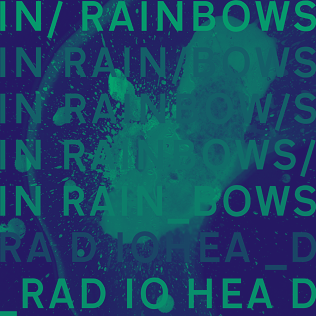
You could say I’m a fan of Radiohead. You could say I’ve spent more than half of my life listening to them, own all of their albums, tattooed myself with lyrics from Karma Police before I was even 20 years old, have seen them in concert on multiple occasions and in multiple countries, each experience rapturous. Yes, you could say I am invested.
And yet, today I sit here disillusioned by this group of five men from Oxfordshire, who are nowadays looking much less like keen-eyed and sharp-tongued auteurs and more like lolling middle-aged rock stars (Jonny Greenwood basically said as much while promoting his artisanal olive oil brand — the very existence of which says all you need to know). Nowhere has this shift felt more apparent than the band’s “can’t we all just get along” stance on Palestine.
This isn’t new territory for Radiohead, admittedly. Ahead of a 2017 Radiohead concert in Tel Aviv, Roger Waters publically encouraged Radiohead to cancel the concert in support of the BDS movement. This came after repeated attempts at private discussion. Many Radiohead fans expressed support for Waters’ perspective. Thom Yorke responded in a lengthy statement that lambasted Waters and BDS — saying that their “black and white” way of thinking was unproductive, and demands paternalistic at best. The concert went on as planned.
Now, in light of the daily starvation, murder, and ethnic cleansing happening in Gaza, fans have renewed their requests to the band to stand up for Palestine. I am among them. I admit, my desire to have Radiohead speak on the issue is rooted in equal parts altruism and selfishness. I believe that we all have a moral calling to amplify the cries of Palestinians to the best of our ability. I also hope that artists who have been so important to me are brave enough to agree.
Last week, Thom Yorke — who, by the way, has released four albums and toured extensively in the last two years — finally released a statement via his Instagram. I admit I was optimistic as I began reading Yorke’s perspective on, as he put it, “the unfolding humanitarian catastrophe in Gaza.” My hopes quickly fell.
What could have been a long-awaited opportunity to correct the record and join the chorus of voices in support of the oppressed was, instead, a pale lamentation on celebrity coupled with half-baked centrist politics. Yorke expressed surprise that his “supposed silence was somehow being taken as complicity” and that the “social media witch-hunts” have taken a “heavy toll on [his] mental health.” I can’t say for sure, but I imagine the mental health toll of watching your entire family burn alive is likely worse.
Yorke pressed on: “[T]he unquestioning Free Palestine refrain that surrounds us all does not answer the simple question of why the hostages have still not all been returned?” Ignoring the fact that this sentence structure resembles a college freshman’s attempt to appear erudite, Yorke’s derision of pro-Palestinian activists as unthinking horde cut to my core; cut through 15 years of admiration, late nights driving home alone, taking the long way so I could sing along to In Rainbows, posters taped above bedframes, and songs carefully selected for mix tapes.
The man I have so long felt a connection with has turned out to be a paper-thin bourgeois faux-intellectual fence-straddler. His words are the words of those who wish to be perceived as progressive, while maintaining their access to comfort and power.
Yorke’s statement concluded with finger-pointing at Netenyahu and Hamas, as opposed to a century-old colonial settler project, and platitudes about how much is meant to transcend borders and other self-serving bullshit. Maybe the fault was mine to begin with. What was I thinking, idolizing a 56-year-old British man? It was a project doomed to fail from the start. Either way, I am left wondering where to go from here.
Maybe I shouldn’t wonder too hard. Centering myself and my feelings makes me no better than the man who I have allowed to let me down for the last time.
Unfortunately, I am thinking about Substack again.
This latest period of anxious hyperfixation was brought on by the recent New Yorker article “Is the Next Great American Novel Being Published on Substack?” Though I think the answer is clearly “no,” the author of the New Yorker piece paints an of-the-moment portrait of literary life playing out across newsletters that left me feeling restless.
Of course I have pondered starting a newsletter! I have gone so far as to register for a Substack account, spend several hours formatting my page just so, and then proceeding to never write a single word.
Though I envy the writers who have managed to transform Substack into a vehicle for literary buzz and PayPal account deposits, I know I don’t have what it takes to do the same. It’s not because I don’t think I can write snarky Selling Sunset recaps as well as the next former NYU student — it’s because I really, truly do not care to read anyone else’s Substack. I cannot bring myself to care! My inbox is a sea of expired Sephora coupons and articles about unlikely animal friendships shared by my parents — how could one person possibly have the capacity to add thinkpieces about Sally Rooney to that mix? I simply cannot do it!
Present here is also an element of fear. The rise of Substack writing is symbiotic with the ways that writers — and artists in general — are increasingly expected to exist as a brand; a commodity for consumption. So and so is the ethereal fashion critic, the socialist political analyst, the pop culture connoisseur. Am I afraid because I don’t wish to box myself in — or because I am afraid that I don’t have a point of view?
I write this blog — obviously. I used to write regularly on Medium, though I think the site has all but dissipated into irrelevance. I sometimes wonder if Substack is doomed to a similar implosion. Having this wee corner of the internet feels different than having a newsletter, though. It simply exists. I can convince myself I am writing in the spirit of Mark Fisher! (She said only somewhat ironically).
As I sit here and ponder these asinine questions, the fact is really this: I have spent the last 10 or so years waiting around for a formal invitation into the literary community. Literally. I have basically imagined that one day Emily Greenhouse is going to send me a letter formally inviting me into the inner circle of the literary elite. Then I will be taken seriously!
My bitter streak is no secret. I have aligned myself with the type of modern writer who longs for a literary world that no longer exists, despite the fact I’ve never actually lived in that world myself. My adolescence was dominated by blogs, and my early 20s was the golden era of Vice and BuzzFeed, before those publications gave way to pathetic union busting and eventual uselessness.
When I read an article like the New Yorker piece, about what all of these wonderful writers are doing, it’s like I imagine a big room filled with interesting conversation, and I am peering through the window, my heavy breath fogging up the glass. I imagine something concrete and tangible, when the reality is that community is what you made of it. And that is an incredibly frustrating realization because it means that such a thing could never live up to the dreampalace that I have spent so long constructing.
But maybe that also means I don’t have to wait for the invitation anymore. Maybe it means the power is in my hands.
It’s difficult for me to write about “Nana” because the series has shaped me more than any other book, movie, tv show, album. I have long said I will write some definitive piece about the series, but can never actually bring myself to do so. In the meantime, I am re-reading the series as part of a virtual book club and enjoying every moment.
角野 栄子 の 「魔女の宅急便」| “Kiki’s Delivery Service” by Eiko Kadono
Kiki’s Delivery Service may well be my favorite film by one of my favorite directors, so of course I had to read the book that inspired the movie. My Japanese is at a level where enjoying middle-grade literature is no problem — yet this book has proven extremely challenging. It’s full of slang and dialect that’s hard to parse on the page. As a result, what should be a fun and light read has taken me now more than 6 months to slog through.
あずまきよひこの「よつばと!」v16 ”Yotsuba” vol. 16 by Kiyohiko Azuma
“The Legend of Meneka” by Kritika H. Rao
“Fifty Sounds” by Polly Barton
Barton is one of my favorite translators of Japanese to English, so I was very happy to come across this book at the library. Part memoir, part theory, part unnecessary references to Kierkegaard. Though I am not sure I am actively enjoying this book, I am glad it crossed my path.
“If Only” by Vigdis Hjorth
I am captivated by this extremely strange novel. I was previously unfamiliar with Hjorth, but quickly became interested when the book jacket touted her as the “Nordic Annie Ernaux.”
Bralette Zine vol. 1
I bought this zine on a whim when I stopped in to the lovely Print Bookstore in Portland, Maine. It’s delightful!
“This is How You Lose the Time War” by Amal El-Mohtar and Max Gladstone
I need to rectify my status as “the only person who hasn’t read this.”
“The Goodbye Cat” by Hiro Arikawa
Since the passing of my beloved feline companion Torby in January, I have been reading a wealth of cat-themed literature. The Travelling Cat Chronicles has perhaps been my favorite. That novel absolutely broke my heart in the most beautiful and cathartic way. The Goodbye Cat is the follow-up.
青木美沙子の 「まっすぐロリータ道」| “I’ll Always be a Lolita” by Misako Aoki
“The Song of Achilles” by Madeline Miller
Again, am I the only person who hasn’t read this? I’ve been contemplating doing a “summer reading list” like we used to do in school, and I think this would be at the top of the list.
“Read Real Japanese” edited by Michael Emmerich
“Light in Gaza” edited by Jehad Abusalim, Jennifer Bing, and Mike Merryman-Lotze
“The Artist’s Way” by Julia Cameron
I committed to The Artist’s Way program last year, but fell off about halfway through. I think it’s a wonderful, generative, and restorative exercise. This is languishing on my nightstand as a reminder that I should give it another go.
クッキー雑誌2024年11月刊 | Cookie Magazine, November 2024 Edition
Am I actively reading all of these books? No. Is it comforting to know that certain books are just a stretch away at any given moment? Yes.



 Katie Fustich